




 On eBay Now...
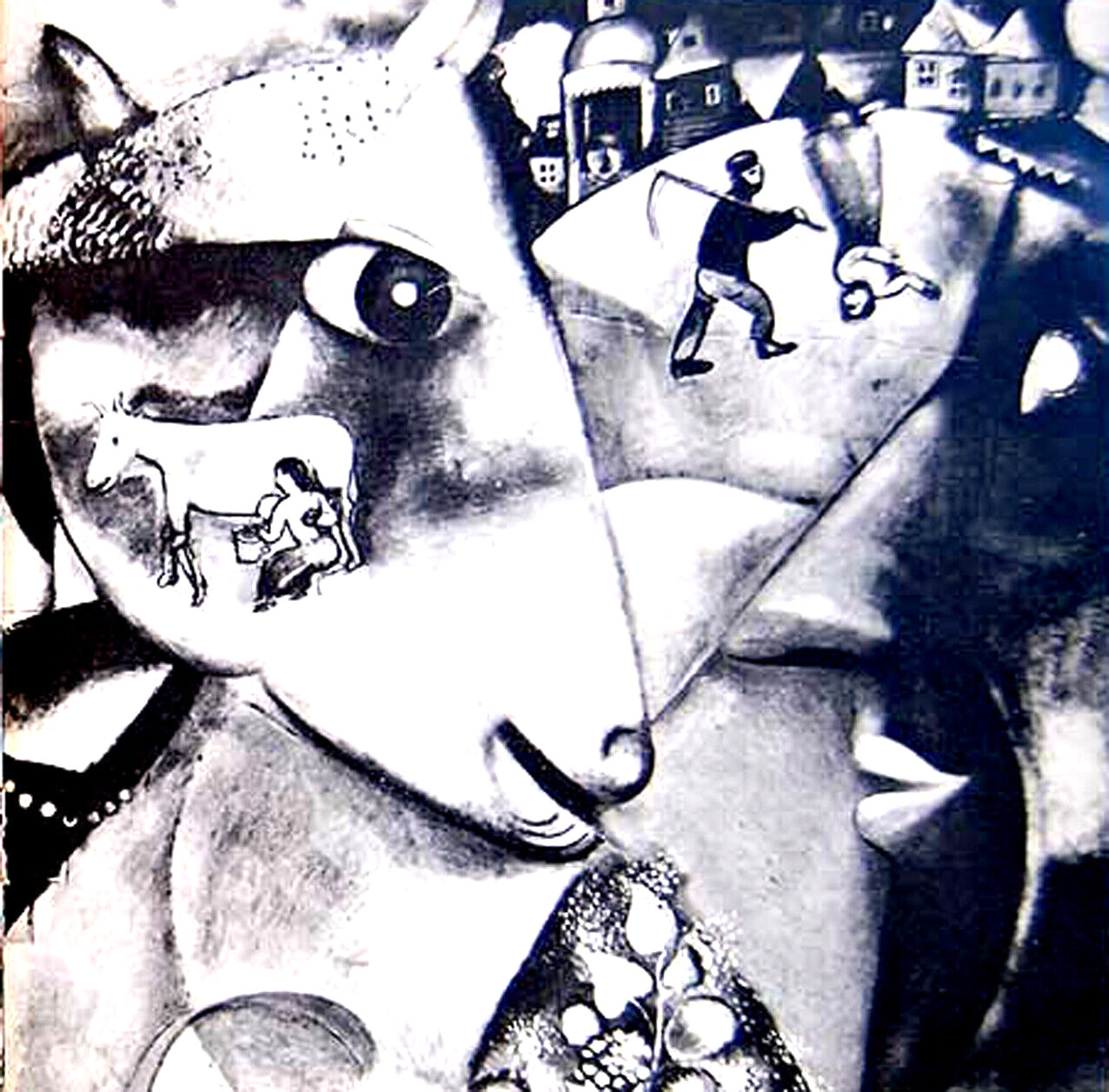
1963 Judaica RARE JAPANESE Catalog JEWISH Russian AVANT GARDE Book MARC CHAGALL For Sale
When you click on links to various merchants on this site and make a purchase, this can result in this site earning a commission. Affiliate programs and affiliations include, but are not limited to, the eBay Partner Network.

1963 Judaica RARE JAPANESE Catalog JEWISH Russian AVANT GARDE Book MARC CHAGALL:
$65.00
DESCRIPTION: In 1963, 60 years ago , This EXHIBITION of the JEWISH artist , Once among the founders and participants of the Jewish-Russian Avant-Garde art stream MARC CHAGALL , Took place in JAPAN . Here for sale is the exceptionaly RARE and quite odd collectible item - The ILLUSTRATED CATALOGUE of that 1963 Japanese exhibition .All its40 chromo pages are throughout illustrated and photographed , Loaded with beautiful as much as useful information.( That is , If you can read Japanese ......). Original illustratedSC .7 x 7" .Around 40throughout illustrated pp. Japanese . Chromo leaves. Very good condition. Clean. Slight foxing of cover.( Pls look at scan for accurate AS IS images ) .Will be sent inside a protective rigid packaging.AUTHENTICITY :Thisis anORIGINALvintage1963 publication, NOT a reproduction or a reprint ,It holds a life long GUARANTEE for its AUTHENTICITY andORIGINALITY.PAYMENTS : Payment method accepted :Paypal .SHIPPMENT : SHIPP worldwide via registered airmail is $ 35 . Will be sent inside aprotective packaging.Handling around 5-10 days after payment.
Marc Chagall (7 July 1887 – 28 March 1985) was a Russian Jewish artist associated with several key art movements and was one of the most successful artists of the twentieth century. He forged a unique career in virtually every artistic medium - from his early Cubist paintings to his book illustrations, stage sets, ceramics, stained glass windows, tapestries and fine art prints, Chagall's haunting, exuberant, and poetic images have enjoyed universal appeal. As a pioneer of modernism and one of the greatest figurative artists of the twentieth century, Marc Chagall achieved fame and fortune, and over the course of a long career created some of the best-known and most-loved paintings of our time. According to art historian Michael J. Lewis, Chagall was considered to be “the last survivor of the first generation of European modernists.” For decades he “had also been respected as the world’s preeminent Jewish artist.” He also accepted many non-Jewish commissions, including a stained glass for the cathedrals of Reims and Metz, a Dag Hammarskjold memorial at the United Nations, and the great ceiling mural in the Paris Opera. His most vital work was made on the eve of World War I, when he traveled between St. Petersburg, Paris, and Berlin. During this period he created his own mixture and style of modern art based on his visions of Eastern European Jewish folk culture. He spent his wartime years in Russia, and the October Revolution of 1917 brought Chagall both opportunity and peril. He was by now one of the Soviet Union's most distinguished artists and a member of the modernist avante-garde. He founded the Vitebsk Arts College, which was considered the most distinguished school of art in the Soviet Union.He was known to have two basic reputations, writes Lewis - as a pioneer of modernism, and as a major Jewish artist. He experienced modernism’s golden age in Paris, where “he synthesized the art forms of Cubism, Symbolism, and Fauvism, and the influence of Fauvism gave rise to Surrealism.” Yet throughout these phases of his style "he remained most emphatically a Jewish artist, whose work was one long dreamy reverie of life in his native village of Vitebsk." “When Matisse dies,” Pablo Picasso remarked in the 1950s, “Chagall will be the only painter left who understands what color really is.”Marc Chagall was born in Liozno, near Vitebsk, now in Belarus, the eldest of nine children in a close-knit Jewish family led by his father Khatskl (Zakhar) Shagal, a herring merchant, and his mother, Feige-Ite. This period of his life, described as happy though impoverished, appears in references throughout Chagall's work. The family home on Pokrovskaya Street is now the Marc Chagall Museum.He began studying painting in 1906 with a local artist, Yehuda Pen. In 1907, he moved to St. Petersburg. There he joined the school of the Society of Art Supporters and studied under Nikolai Roerich. It was here that he was exposed to experimental theater and the work of such artists as Gauguin. From 1908-1910 Chagall studied under Leon Bakst at the Zvantseva School of Drawing and Painting.This was a difficult period for Chagall; at the time, Jewish residents were only allowed to live in St. Petersburg with a permit, and the artist was jailed for a brief period for an infringement of this restriction. Despite this, Chagall remained in St. Petersburg until 1910, and regularly visited his home town where, in 1909, he met his future wife, Bella Rosenfeld.After gaining a reputation as an artist, Chagall left St. Petersburg to settle in Paris to be near the burgeoning art community in the Montparnasse district, where he developed friendships with such avant-garde luminaries as Guillaume Apollinaire, Robert Delaunay, and Fernand Léger. In 1914, he returned to Vitebsk and, a year later, married his fiancée, Bella. While in Russia, World War I erupted and, in 1916, the Chagalls had their first child, a daughter named Ida.Chagall became an active participant in the Russian Revolution of 1917. Although the Soviet Ministry of Culture made him a Commissar of Art for the Vitebsk region, where he founded Vitebsk Museum of Modern Art and an art school, he did not fare well politically under the Soviet system. He and his wife moved to Moscow in 1920 and then back to Paris three years later, in 1923. During this period, Chagall published his memoirs in Yiddish, which were originally written in Russian and translated into French by Bella. He also wrote articles, poetry and memoirs in Yiddish, published mainly in newspapers (and only posthumously in book-form). Chagall became a French citizen in 1937.With the Nazi occupation of France during World War II and the deportation of Jews, the Chagalls fled Paris, seeking asylum at Villa Air-Bel in Marseille, where the American journalist Varian Fry assisted in their escape from France through Spain and Portugal. In 1941, the Chagalls settled in the United States.MarriagesHis wife Bella, who appears in many of his paintings, died on September 2, 1944. In 1945, he began a relationship with his housekeeper Virginia Haggard McNeil, with whom he had a son, David. In the 1950s, they moved to a villa in Provence. Virginia left him in 1952, and Chagall married Valentina Brodsky (whom he called "Vava").Later lifeHe traveled several times to Greece and visited Israel in 1957. During this time, he rediscovered a free and vibrant use of color. His works of this period are dedicated to love and the joy of life, with curved, sinuous figures. He also began to work in sculpture, ceramics, and stained glass.In a recent book review of Chagall's biography, author Serena Davies writes, "By the time he died in France in 1985 - the last surviving master of European modernism, outliving Joan Miró by two years - he had experienced at first hand the high hopes and crushing disappointments of the Russian revolution, and had witnessed the end of the Pale, the near annihilation of European Jewry, and the obliteration of Vitebsk, his home town, where only 118 of a population of 240,000 survived the Second World War." She later adds that the book "leaves us finally with an image of a man who came from nowhere to achieve world-wide acclaim. Yet his fractured relationship with his Jewish identity - he was physically divorced from his homeland, and he wasn't a practising Jew - was unresolved and tragic. After his death his wife arranged burial for him in a Christian cemetery. He would have died with no Jewish rites, had not a stranger stepped forward and said the kaddish, the Jewish prayer for the dead, over his coffin."Artistic careerChagall took inspiration from Belarusian folk-life, and portrayed many Biblical themes that reflected his Jewish heritage. In 1950 he began experimenting with graphic mediums. After meeting with Fernand Mourlot, he often visited Mourlot Studios where he eventually produced close to a thousand different lithographic editions. With the assistance of Charles Sorlier, a master printer working at Mourlot, he spent 30 years exploring the graphic medium that most lends itself to color representation. Charles Sorlier also became one of his closest friends, assistant and counsel until the day of his death.In the 1960s and 1970s, Chagall engaged in a series of large-scale projects involving public spaces and important civic and religious buildings. For example, 200,000 visitors a year visit St. Stephen’s cathedral in Mainz, Germany. "Tourists from the whole world pilgrim up St. Stephen’s Mount, to the glowing blue stained glass windows by the artist Marc Chagall," states the city's web site. "St. Stephen’s is the only German church for which the Jewish artist Marc Chagall (1887 - 1985) created windows." The website also states, “The colours address our vital consciousness directly, because they tell of optimism, hope and delight in life”, says Monsignor Klaus Mayer, who imparts Chagall’s work in mediations and books. He established contact with Chagall in 1973, and succeeded in persuading the “master of colour and the biblical message” to set a sign for Jewish-Christian attachment and international understanding in the east chancel. In 1978, the first Chagall window by the then 91-year-old artist was fitted. A further eight followed, six for the east chancel and three in the transept."Chagall's artworks are difficult to categorize. Working in the pre-World War I Paris art world, he was involved with avant-garde currents, however, his work was consistently on the fringes of popular art movements and emerging trends, including Cubism and Fauvism, among others. He was closely associated with the Paris School and its exponents, including Amedeo Modigliani.Abounding with references to his childhood, Chagall's work has also been criticized for slighting some of the turmoil which he experienced. He communicates happiness and optimism to those who view his work strictly in terms of his use of highly vivid colors. Chagall often posed himself, sometimes together with his wife, as an observer of a colored world like that seen through a stained-glass window. Some see The White Crucifixion, which is rich with intriguing detail, as a denunciation of the Stalin regime, the Nazi Holocaust, and the oppression of Jews in general.Theater sets and costumesAfter the Bolshevik Revolution, the Russian Jewish theater became a catalyst for modernist experimentation. Chagall and other artists were hired to produce theater sets and costumes combining Russian folk art with elements of Cubo-Futurism and Constructivism. Stained glass windowsIn 1960, he created stained glass windows for the synagogue of the Hadassah Ein Kerem hospital in Jerusalem. During the Six-Day War the hospital came under severe attack, placing Chagall's work under threat. In response to this, Chagall wrote a letter from France stating "I am not worried about the windows, only about the safety of Israel. Let Israel be safe and I will make you lovelier windows." Luckily, most of the panels were removed in time, with only one sustaining severe damage. In 1973, Israel issued a series of stamps featuring the Chagall windows, which depict the Twelve tribes, such as Levi, pictured there.The U.N. public lobby has a stained-glass window designed by Chagall and was a gift from United Nations as well as Marc Chagall himself. It was presented in 1964 as a memorial to Dag Hammarskjold, the second Secretary-General of the UN, and fifteen other people who died with him in a plane crash in 1961.The U.N. website describes the stained glass a "memorial, which is about 15 feet wide and 12 feet high, contains several symbols of peace and love, such as the young child in the center being kissed by an angelic face which emerges from a mass of flowers. On the left, below and above motherhood and the people who are struggling for peace are depicted. Musical symbols in the panel evoke thoughts of Beethoven's Ninth Symphony, which was a favourite of Mr. Hammarskjold's.".TapestriesChagall also designed tapestries which were woven under the direction of Yvette Cauquil-Prince, who also collaborated with Picasso. These tapestries are much rarer than his paintings, with only 40 of them ever reaching the commercial market. Chagall designed three tapestries for the state hall of the Knesset in Israel, along with 12 floor mosaics and a wall mosaic. Etchings and ceramicsIn 1930, Chagall was commissioned to do a series of Bible prints by Parisian art dealer Ambroise Vollard. Chagall spent three months in Palestine to paint preparatory gouaches. He completed 66 of the plates by 1939, and returned to the project 13 years later, after the Holocaust. These hand-colored etchings, completed in 1956, illustrated scenes from the Old Testament in Chagall's unique style. Like Picasso, Chagall worked on ceramics. However, none of Chagall's pieces were made into editions and they are exceedingly rare and can be seen in only a few museums throughout the world.Chagall's work is housed in a variety of locations, including the Palais Garnier (the old opera house), the Chase Tower Plaza of downtown Chicago, the Metropolitan Opera, the Metz Cathedral, Notre-Dame de Reims, the Fraumünster abbey in Zürich, Switzerland, the Church of St. Stephan in Mainz, Germany and the Biblical Message museum in Nice, France, which Chagall helped to design.The only church in England with a complete set of Chagall window-glass is located in the tiny village of Tudeley, in Kent, England. Chagall painted 12 colorful stained-glass windows in Hadassah Hospital Ein Kerem in Jerusalem, with each frame depicting a different tribe. In the United States, the Union Church of Pocantico Hills contains a set of Chagall windows commemorating the prophets, which was commissioned by John D. Rockefeller, Jr. At the Lincoln Center in New York City, Chagall's huge murals, The Sources of Music and The Triumph of Music, are installed in the lobby of the new Metropolitan Opera House, which opened in 1966. Also in New York, the United Nations Headquarters has a stained glass wall of his work. In 1967 the UN commemorated this artwork with a postage stamp and souvenir sheet.In 1973, the Musée National Message Biblique Marc Chagall (Chagall Museum) opened in Nice, France. The museum in Vitebsk which bears his name was founded in 1997, in the building where his family lived, although, prior to his death, years before the fall of the Soviet Bloc, Chagall was persona non grata in his homeland. The museum has only copies of his work.In 2007, an exhibition of his work, “Chagall of Miracles,” at Il Complesso del Vittoriano, included the Red Jew (1915), Above the City (1914-1918), Composition with Circles and Goat (1920), and The Fall of the Angel (1923-1947). Despite the fact that he was a Jew, he employed Christian iconography. He was also a dreamer whose works touched on the harsh realities of war and persecution. The works in this exhibition highlighted these aspects of Chagall's work. 151folder202 Related Items:

1963 סדור עם ישראל Siddur Am Yisrael Hebrew Ashkenaz Sinai Israel Judaica
$24.99

Jewish Judaica israel israeli Air Force Mamram IDF prize plane statue 1963 ממרם
$438.90

Silver Jeweled torah / Judaica Gift Hebrew (Missing Two Gems) 1963 Israel
$139.95