




 On eBay Now...
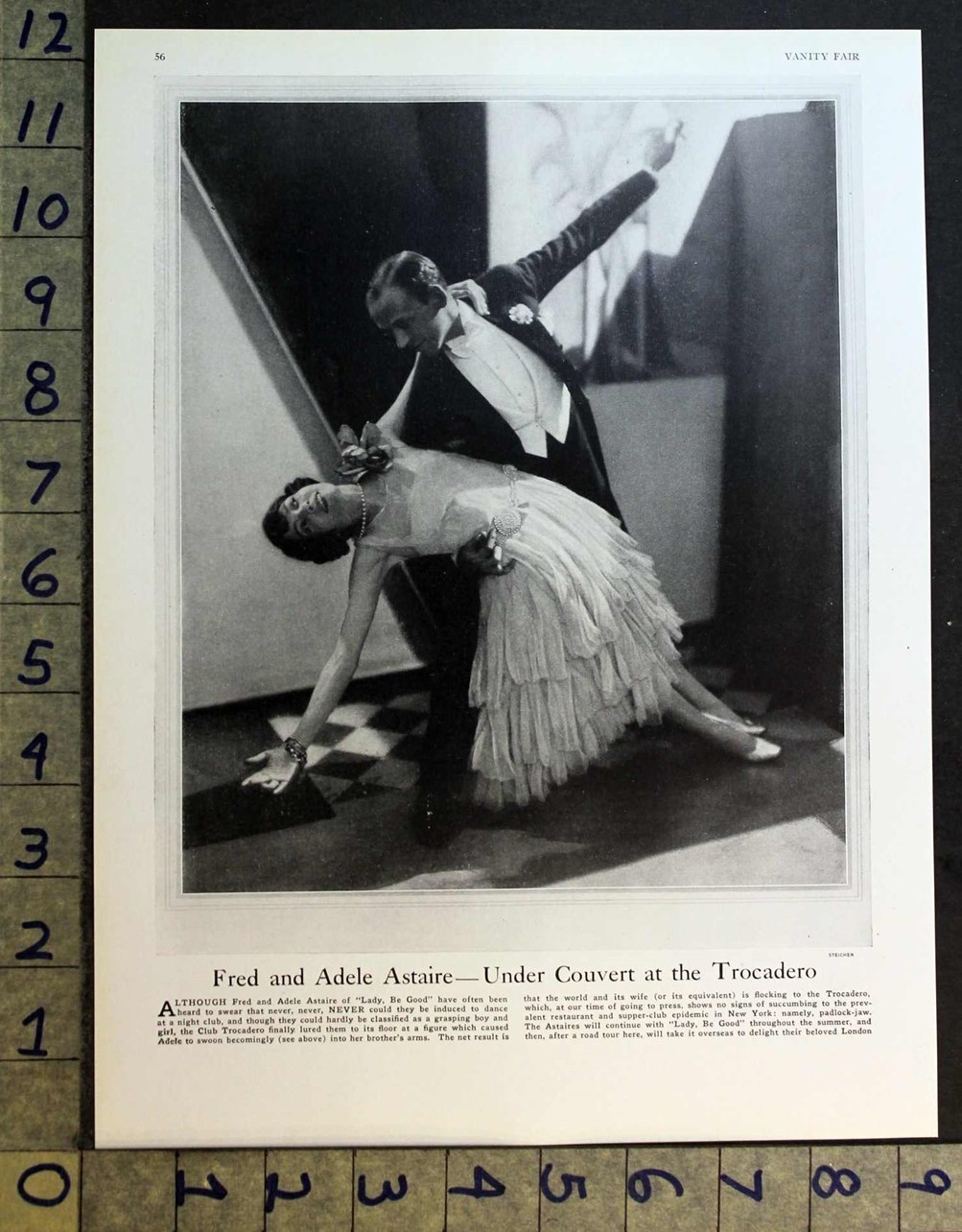
1925 ADELE FRED ASTAIRE TROCADERO DANCER LADY BE GOOD PHOTO INSERT PRINT FC9382 For Sale
When you click on links to various merchants on this site and make a purchase, this can result in this site earning a commission. Affiliate programs and affiliations include, but are not limited to, the eBay Partner Network.

1925 ADELE FRED ASTAIRE TROCADERO DANCER LADY BE GOOD PHOTO INSERT PRINT FC9382:
$84.95
1925 ADELE FRED ASTAIRE TROCADERO DANCER LADY BE GOOD PHOTO INSERT PRINT FC9382 DATE OF THIS**ORIGINAL** ITEM:1925
THIS ITEM IS A ONE-PAGEPRINTFROM ANORIGINALPERIODICAL.THEREIS ONEPHOTO, SO PLEASELOOK OVER CAREFULLY FOR SIZE AND CONDITION! NOTE: SOME PHOTOS MAY HAVE A BLACK BOX COVERING UP THE NAME OF THE PERIODICAL - IT IS ONLY LAYING ON TOP OF THE ITEM - NOT PERMANENT.
ILLUSTRATOR / ARTIST:B/WREAL PHOTO INSERT PAGE - PHOTOGRAPHER STEICHEN
OTHER INFO OF CONCERN FOR THIS LISTING - SPECIAL CHARACTERISTICS AND DESCRIPTIVE WORDS:
Adele Astaire Douglass(bornAdele Marie Austerlitz, later known asLady Charles Cavendish; September 10, 1896– January 25, 1981) was an American dancer, stage actress, and singer. After beginning work as a dancer andvaudevilleperformer at the age of nine, Astaire built a successful performance career with her younger brother,Fred Astaire.
The brother and sister act initially worked their way through vaudeville circuits, finally achieving a breakthrough with their firstBroadwayroles in 1917. Astaire became known for her talents as a skilled dancer and comedienne, starring in hit Broadway musicals such asLady, Be Good!(1924),Funny Face(1927) andThe Band Wagon(1931).The siblings took several of their more popular shows to Britain'sWest Endduring the 1920s, where they were soon international celebrities, meeting members of the British royal family and prominent figures from contemporary arts and literature circles.
In 1932, after a 27-year partnership with her brother, Astaire retired from the stage to marryLord Charles Arthur Francis Cavendish, the second son ofVictor Cavendish, 9th Duke of Devonshire. The couple moved to the Cavendish estate ofLismore Castlein Ireland. Despite offers of both stage and film roles from producers eager to see her return to acting, Astaire declined to come out of retirement. Following Cavendish's death in 1944, Astaire remarried and moved back to the United States. She divided her time between properties in the United States; Round Hill, Jamaica; and her old home of Lismore Castle, where she spent her summers up until the end of her life.
In 1972, Astaire was inducted into theAmerican Theater Hall of Fame.
In 1975, Astaire was inducted into theInternational Best Dressed Hall of Fame List.
In 1917, after Fred carefully purchased a full-page advertisement on the back cover ofVariety, the siblings landed a part in their first Broadway show,Lee Shubert'sOver the Top. Adele was 21, while her brother was 18. The show opened on November 28, 1917,and the siblings received a weekly salary of $250 (equivalent to $6100 in 2024) for their assigned dance numbers and comedy skits.A critic fromThe New York Globecommented that the dancing of Adele and her brother was "one of the prettiest features of the show", and the production ran for 78 performances.To prepare for her work singing in Broadway musicals during the late 1910s and 1920s, she took voice lessons withEstelle Lieblingwho was the voice teacher of many famous singers at theMetropolitan Operaand on Broadway.
Adele and Fred performed inThe Passing Show of 1918, which ran for 125 performances.Astaire was given an opening solo, singing "I Really Can't Make My Feet Behave".In November 1919, the Astaires appeared in the operettaApple Blossoms, beginning a professional relationship with Broadway producerCharles Dillingham. The show was successful, running for 256 performances. Fritz came to see his children perform. Their weekly salary was now $550, which rose to $750 (equivalent to $11500 & $11800 in 2024) whenApple Blossomsbegan its post-Broadway tour from September 1920 to April 1921.Unlike her brother, who struggled with shyness offstage, Astaire's outgoing personality made it easy for her to speak to reporters.
Although their next showThe Love Letterwas a commercial flop, opening in October 1921 and running for only 31 performances,Astaire and her brother continued to garner appreciation from audiences, and here they introduced what would become one of their signature exit moves, the Runaround. Standing shoulder to shoulder at the end of a dance number, the siblings would put their arms out as if grasping the handlebars of bicycles, running around the stage together in ever-growing circles while the orchestra played "a series of oompahs".At last, Adele and Fred would disappear into the wings.Audiences loved it. Fred attributed the popularity of the Runaround to his sister's comedic timing and expressions, and the siblings found ways to incorporate the move into almost every show of their subsequent career together.While visiting New York for the first time that year, English playwrightNoël CowardsawThe Love Letterand was impressed by the Astaires. He came to meet them backstage, urging them to consider taking their performances to London.
In 1922, Adele and Fred landed their first proper speaking roles in the Broadway musicalFor Goodness Sake, playing the best friends of the lead characters. They received positive reviews from critics,and sang the hit song "The Whichness of the Whatness", concluding the piece with their increasingly popular Runaround exit. With the success of this show, Fred began taking more of a lead in choreographing their routines.The siblings finally received star billing in the short-livedThe Bunch and Judy, earning $1000 (equivalent to $18800 in 2024) weekly. Drama criticHeywood Brouncalled the Astaires "the most graceful and charming young dancers in the world of musical comedy".
As the siblings continued to rise professionally, Adele quickly became known for her comedic expressions and "adorably squeaky" soprano voice.She often ad-libbed onstage.She gave high-spirited performances, delighting audiences with her zany humor; Fred developed his own more understated style in response, dancing with a characteristic "pretence of nonchalance" that he would carry on using throughout his dancing career.Adele and her brother developed a dancing style involving complex steps performed rapidly and gracefully, often compared to "a whirlwind" by critics and audiences.
After the idea of performing overseas was suggested, Adele and Fred agreed to takeFor Goodness Sake(renamedStop Flirting) to theWest Endin London. On May 30, 1923, their show opened at theShaftesbury Theatreand received a standing ovation. Stop Flirtingran for 418 performances. It moved to theQueen's Theatre, followed by theStrand Theatre.The Prince of Walesattended the show ten times, and both he and his brotherthe Duke of Yorkbecame friends with the siblings. Adele taught Edward some new tap dance steps, and the pair once danced together at a club.As the Astaires' popularity grew, both Adele and Fred were featured in major advertising campaigns.While in London,Peter PancreatorJ. M. Barrieasked Adele to play his creation on stage, but contractual reasons forced her to turn down the part.In early 1924, Adele received word that her father, Fritz, had died from cancer.
Returning to New York in late 1924, Adele and her brother starred inLady, Be Good!, the first Broadway musical scored entirely byGeorgeandIra Gershwin. It was a hit with audiences, running for 330 performances. The siblings earned $1750 per week. One critic called Adele the most charming and entertaining musical actress seen "in many a moon".In the spring of 1926, Adele and her brother tookLady, Be Good!to London, opening at theEmpire Theatreto enthusiastic reception. The siblings renewed their acquaintance with the British royal family, receiving an invitation from the Duke andDuchess of Yorkto meet the newbornPrincess Elizabeth. KingGeorge VandQueen Maryalso made a special visit to see the Astaires perform.
In 1927, Adele and Fred joined forces with the Gershwin brothers again in New York for their new musicalFunny Face. The show was another hit.Shortly after the opening, the Astaires arranged for a film screen test withParamount Pictures. The film studio hoped to feature Adele and her brother in a film version ofFunny Face, but the siblings were both unsatisfied with the initial screen test results, and the project never went ahead.On the Broadway stage,Funny Faceran for 250 performances, closing only due to a summer heatwave in 1928 that made theaters too hot for audiences and performers. That summer, Adele was injured in an accident onLong Islandwhen a motorboat engine exploded, scalding her upper body with burning oil. Although her career was put on hold for a few months, she made a full recovery.
The Astaires' London debut ofFunny Facetook place in November 1928. The show ran for 263 performances, and British newspapers hailed "another outbreak of 'Astairia'" as audiences embraced the American duo once again.On the night of their final performance in London, Adele was introduced toLord Charles Cavendish, the second son ofthe 9th Duke of Devonshire.Cavendish was several years younger than Adele. The pair were quickly attracted to each other, spending time together in Paris before Adele returned to America with Fred. They met again soon afterwards when Cavendish came to New York and took a position withJ.P. Morgan & Co.
Although their next show,Smiles(1930), was a commercial flop, Adele and her brother soon made their comeback with another hit, starring in their final Broadway show together,The Band Wagon, which opened on June 3, 1931, and ran for 260 performances.Other members ofThe Band Wagon'scast includedTilly Losch,Helen BroderickandFrank Morgan.Critics applauded the creative, decidedly modern writing and set design of the show, which included a custom-built "double revolve" turntable stage: the turntable revolved in two directions at once, revealing new scenes quickly and smoothly while the performers danced and sang.
Fred Astaire(bornFrederick Austerlitz,May 10, 1899 – June 22, 1987) was an American dancer, actor, singer, musician, choreographer, and presenter, whose career in stage, film, and television spanned 76 years. He is widely regarded as the "greatest popular-music dancer of all time".He received anHonorary Academy Award, aBAFTA Award, threeEmmy Awards, twoGolden Globe Awards, and aGrammy Award.
As a dancer, he was known for his uncanny sense of rhythm, creativity, effortless presentation, and tireless perfectionism, which was sometimes a burden to co-workers. His dancing showed elegance, grace, originality, and precision. He drew influences from many sources, including tap, classical dance, and the elevated style ofVernon and Irene Castle. His trademark style greatly influenced theAmerican Smoothstyle ofballroom dance. He called his eclectic approach "outlaw style", a following of an unpredictable and instinctive muse. His motion was economical, yet endlessly nuanced.
Astaire's most memorable dancing partnership was withGinger Rogers, with whom he co-starred in ten Hollywood musicals during theclassic age of Hollywood cinema, includingTop Hat(1935),Swing Time(1936), andShall We Dance(1937).Astaire's fame grew in films likeHoliday Inn(1942),Easter Parade(1948),The Band Wagon(1953),Funny Face(1957), andSilk Stockings(1957). For his performance inIrwin AllenandJohn Guillermin's disaster film,The Towering Inferno(1974), Astaire received his only competitive Academy Award nomination forBest Supporting Actor, and he won theGolden Globe Award for Best Supporting Actor – Motion Pictureand theBAFTA Award for Best Actor in a Supporting Role.
Astaire receivedseveral honorsincluding anAcademy Honorary Awardin 1950, theGolden Globe Cecil B. DeMille Awardin 1960, theFilm Society of Lincoln Centertribute in 1973, theKennedy Center Honorsin 1978, andAFI Life Achievement Awardin 1980. He was inducted into theHollywood Walk of Famein 1960,American Theatre Hall of Famein 1972, and theTelevision Hall of Famein 1989. In 1999, theAmerican Film Institutenamed Astaire the fifth-greatest male star of Classic Hollywood cinema in100 Years... 100 Stars.
ADVERTSIZE:SEE RULER SIDES IN PHOTO FOR DIMENSIONS ( ALL DIMENSIONS IN INCHES)
**For multiple purchases please ASK FOR + wait forour combined invoice.Shipping discountareONLYavailable with this method. Thank You.
Our AD's and COVER'Sare ORIGINAL and 100% guaranteed --- (we code all our items to insure authenticity) ---- we stand behind this.
As graphic collectors ourselves, we take great pride in doing the best job we can to preserve and extend the wonderful historic graphics of the past.
PLEASE LOOK AT OUR PHOTO CLOSELY ASIT IS (ALBEIT LOWER RESOLUTION) THE PRODUCT BEING SOLD.....NOT STOCK IMAGES
**NOTE** : PAGES MAY SHOW AGE WEAR AND IMPERFECTIONS TO MARGINS, WITH CLOSED NICKS AND CUTS, WHICH DO NOT AFFECT AD IMAGE OR TEXT WHEN MATTED AND FRAMED. SOMETIMES THE PAGES HAVE BEEN TRIMMED.. PLEASE NOTE THE ACTUAL SIZE OF SELLING AD IN THE ATTACHED PHOTO IMAGE... WHAT YOU SEE IS WHAT YOU GET...
Weship viaUnited States Postal Service.We have a3 day handling time not including weekends or holidays but normally we have all orders processed, packed and shipped within 48 hrs.
A Note to our international buyers (Including Canada). Please read before placing a offer or buying an item:
**Import taxes, duties and charges are not included in the item price or shipping charges. These charges are the buyer's responsibility. Please check with your country's customs office to determine what these additional costs will be prior to offerding/buying on items. These charges are normally collected by the shipping company or when you pick the item up,this is not anadditionalshipping charge. We are not responsible for shipping times to international buyer's. Your country's customs may hold the package for a month or more.
**We pride ourselves on quality products, great service, accurate gradationsand fast shipping.**
BRANCHWATER BOOKS
YOUR AD WILL BE SHIPPED ROLLED IN APROTECTIVE PLASTIC BAG INAN 80mm (TWICE USPSRECOMMENDED) THICK, 2 INCHESIN DIAMETER (SO AS NOT TO STRESS THE PAPER)SHIPPING TUBE WITH PRESS TIGHT PLASTIC END CAPS.
FC9382
Powered by SixBit's eCommerce Solution Related Items:

1925 ADELE FRED ASTAIRE TROCADERO DANCER LADY BE GOOD PHOTO INSERT PRINT FC9382
$84.95

Hollywood ADELE JERGENS CHEESECAKE STUNNING PORTRAIT 1950s Orig Photo 905
$38.49

Adele Mara Hand Signed Blonde Bombshell Portrait Photo 1941 Honolulu Lu J13950
$119.00