




 On eBay Now...
1924 Southern Philatelist Vol 1 No 1 📬 Confederate Postal History Dietz For Sale
When you click on links to various merchants on this site and make a purchase, this can result in this site earning a commission. Affiliate programs and affiliations include, but are not limited to, the eBay Partner Network.

1924 Southern Philatelist Vol 1 No 1 📬 Confederate Postal History Dietz:
$23.95
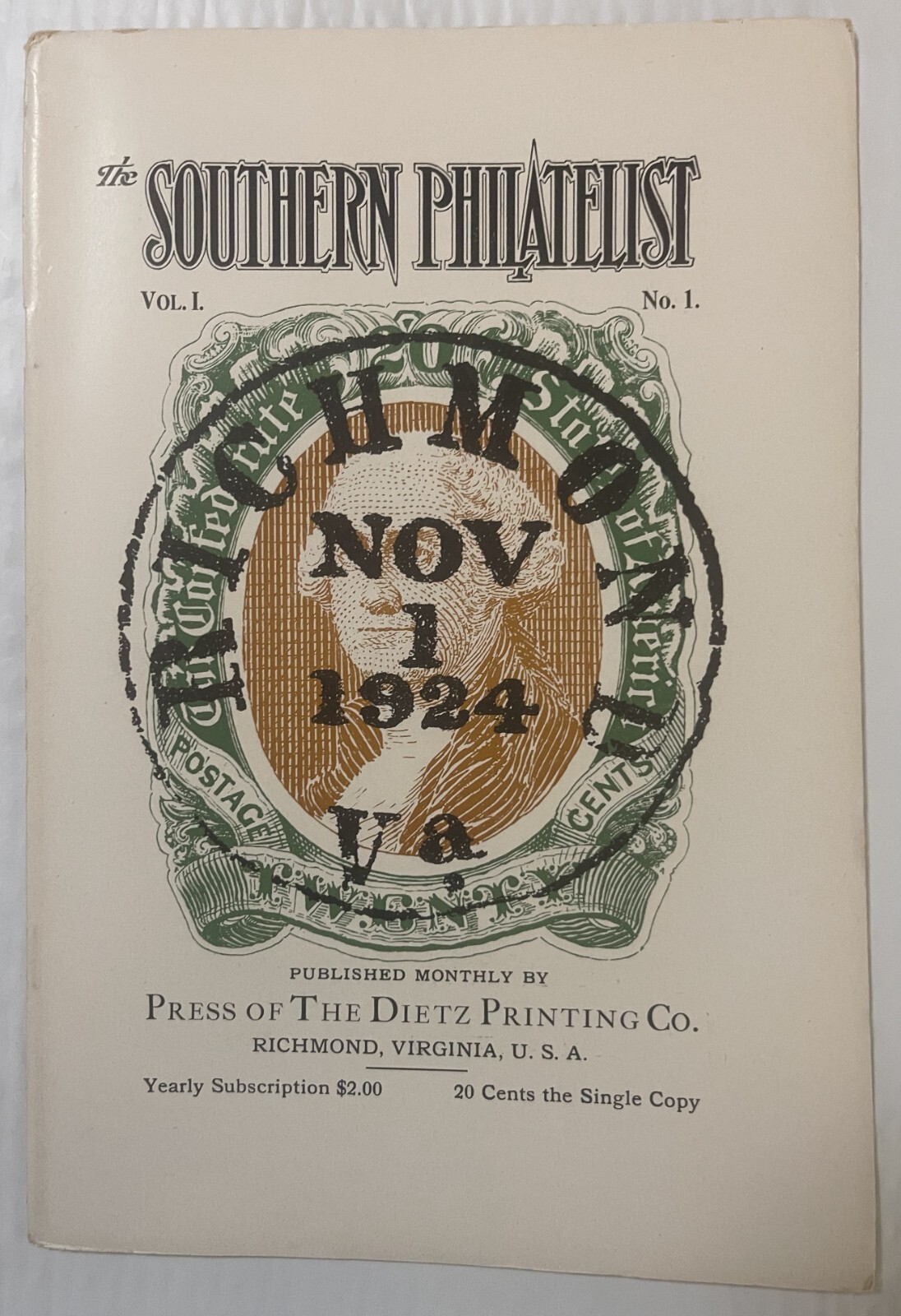
📬 The Southern Philatelist, Vol. I, No. 1 — November 1924 (Inaugural Issue)Offered to collectors of Confederate philately, postal-history literature and Virginia imprints: an original first issue of The Southern Philatelist, Volume I, Number 1, dated November 1924 on its own masthead. It was published monthly by the Press of the Dietz Printing Company, 109 East Cary Street, Richmond, Virginia, edited by August Dietz with August Dietz, Jr. as business manager, and carries the motto “An Exponent of Advanced Philately.” Everything stated here is taken from the issue itself and from the documented record of Confederate philately; it is a genuine antique publication offered exactly as pictured. Price, quantity and listing status are as set in the listing.
🖨️ The Cover DesignThe front cover centers a Confederate twenty-cent stamp design with a Washington portrait, printed in two colors and framed by the legends “Confederate States” and “Twenty Cents,” over which is struck a bold circular postmark reading RICHMOND · NOV 1 1924 · Va. Beneath it is the imprint “Published Monthly by Press of The Dietz Printing Co., Richmond, Virginia, U.S.A.,” with the period terms printed on the cover itself: two dollars yearly, twenty cents the single copy. The design deliberately cancels a modern cover as though it had passed through an old Southern post office — a small, clever emblem of the whole publication's subject. The engraved frame, the two-color printing and the crisp Dietz typography make the cover a fine example of Richmond commercial printing in its own right, quite apart from the philatelic content behind it.
🖋️ The Editor: August DietzThe issue opens with Dietz's editorial “A Come-Back,” in which he recalls launching an earlier journal, The Virginia Philatelist, twenty-seven years before. He describes being drawn into stamp collecting by his schoolmaster around 1878 to 1880, learning lithography, typography and engraving, and running that first magazine for three years — three volumes of thirty-six numbers — from a building he identifies as the one that housed the last post office in the Capitol of the Confederacy. After a quarter century spent building his printing house, he returns here to the editor's chair. August Dietz is recognized as the foremost authority on Confederate philately, and the serialized history begun in this number grew into the standard reference work on Confederate postage stamps. This is, in effect, the first page of that life's work. What comes through even in this opening editorial is the temperament that made him great: a printer's eye for craft, a historian's patience, and a collector's affection for the small, overlooked facts that others walked past.
📯 The Lead History: The Proposal and the buyersThe principal article is the first installment of Dietz's history of the Confederate Post-Office Department and its stamps. A “Prolog” covers the Provisional Congress at Montgomery, the acceptance of the postal portfolio by John H. Reagan, the firing on Fort Sumter on April 12, 1861, and the secession sequence — Virginia, Arkansas, North Carolina, Tennessee, and later Missouri and Kentucky — that made Richmond the seat of Confederate government. An engraving depicts the old Statehouse at Columbia, South Carolina, where the Ordinance of Secession was adopted in December 1860. The narrative then reaches “The Proposal and the buyers”: the Postmaster-General's call for postage stamps of March 27, 1861, published in the Richmond press in early April, and the offers that answered it — from Edmund Hoole, Butler & Carpenter of Philadelphia, George F. Nesbitt, the American Bank Note Company, A. Hoen & Company of Baltimore, J. W. Hayes of Newark, and Hoyer & Ludwig of Richmond. Dietz notes that five of these letters survived in the archives of the United States War Department. The correspondence is reproduced, including A. Hoen & Company's willingness to change the designs to suit and to take part payment in Confederate Treasury Notes, and J. W. Hayes's price of perforated, well-gummed stamps in packages of one hundred sheets at twenty cents per thousand in one color and thirty-five cents in two. Dietz also explains why the department was slow to act on these offers: the removal of the seat of government from Montgomery to Richmond, the transition from Mr. Ellett to General Reagan at the head of the Post-Office Department, and the growing certainty that secession would be followed by war — all of which pushed the decision back until the Postmaster-General could take it up in Richmond.
🖼️ Illustrated Stamp DesignsBecause Virginia had joined the South, the article explains, the contract could not be placed with Northern firms — eliminating every out-of-state buyer and leaving the earliest work to Hoyer & Ludwig of Richmond. The pages illustrate the surviving preliminary and rejected designs: paste-up designs in two colors, a piece labeled “Hoyer & Ludwig's Flag,” three of the four designs offered by A. Hoen & Company (the twenty-cent value already missing), several water-color sketches, a design labeled “probably American Bank Note Co.,” and an essay by an unknown New Orleans artist, closing with “To Be Continued.” This is primary plate-history content for the Hoyer & Ludwig and A. Hoen & Co. story, presented by the collector who assembled it. Dietz praises the artistic treatment of the surviving samples and regrets that several were never adopted for the general issue. For a collector, these illustrations are a rare chance to see the alternatives side by side — the flag motif, the classical portraits, the values that were proposed and set aside — assembled and captioned by the researcher who tracked them down, rather than scattered across separate sources. It is exactly the kind of primary comparison that later handbooks would reproduce and build upon.
📪 Further Contents and Period AdvertisingAlso inside: “Unique Confederate Covers — No. 1,” illustrating a used Confederate one-cent stamp — “the stamp that was never put in use,” prepared abroad and found useless when rates changed — that was fashioned into an envelope by a Federal prisoner at Old Point Comfort and later bore a Northern “Due 3” marking; and “What Constitutes a Confederate 'Local'?”, Dietz's essay on provisionals and hand-stamped PAID envelopes. The advertising pages preserve the 1924 philatelic marketplace — dealers in New York, Philadelphia, London and Springfield, a specialist in stamps issued before 1880 buying Confederate material for cash, a want-ad for eight thousand covers, a London firm's British Colonial Empire bargain, offers referencing Scott's 1925 Catalogue, and the Dietz house's own colophon and book list. As a snapshot of who collected what, and at what prices, in late 1924, the ad pages are almost as interesting as the articles.
📚 For the Confederate CollectorConfederate philately is one of the oldest and most respected specialties in American stamp collecting, and August Dietz stands at the head of it. The serialized study that begins in this very issue — the proposal, the buyers, the Hoyer & Ludwig contract, the rejected essays — is the material he expanded, over the following years, into the reference work that specialists have relied on ever since. That makes a clean run of these early numbers desirable in its own right, and a complete Volume I, Number 1 is the cornerstone of any such run. Because the magazine was aimed at a small, serious readership and printed on inexpensive paper, first issues that survive with both covers, clean pages and no missing leaves are the ones that turn up least often. This is reference literature that also happens to be a collectible artifact: it documents the history of the Confederacy's stamps and, at the same time, it is a piece of that documentary history. It belongs on the shelf of anyone who studies Confederate stamps, wartime Southern printing, Virginia imprints, or the mails of the 1860s — and it reads as well today as it did a century ago, in the plain, confident voice of the man who effectively founded the field.
📐 Condition and Details- Title: The Southern Philatelist, Vol. I, No. 1
- Date on masthead: November 1924 (inaugural issue)
- Editor / Publisher: August Dietz / Press of the Dietz Printing Co., Richmond, Virginia
- Format: original printed paper periodical, approximately 10 in x 6¾ in
- Condition: New Old Stock; complete with front and back covers present; clean, legible interior; light handling and gentle surface undulation consistent with age
- Not a reproduction, reprint or facsimile — an original 1924 printing, offered as pictured
A clean, complete first issue of a scarce specialist journal — early reference literature, a fine example of Richmond printing, and a primary account of how the Confederacy's postage stamps came to be. It sits equally well in a Confederate philatelic library, a postal-history reference shelf, or a Virginia-imprint collection, and it is the kind of first number that rarely surfaces intact. Whether you are building a run of the journal, adding to a Dietz author collection, or simply want one exceptional primary document about the Confederacy's stamps, this inaugural issue is a natural anchor piece — historically important, handsomely printed, and complete.
Related Items:
1924 Southern Railway England Historic Places Fold Out Map Brochure HA Walker
$90.00

1924 Southern Philatelist Vol 1 No 1 📬 Confederate Postal History Dietz
$23.95

1924 Annual Commencement University Southern California Los Angeles
$99.99