




 On eBay Now...
Vintage 📺 Max Headroom Coca-Cola Poster "C-C-C-Catch the Wave" New Coke Ad NOS For Sale
When you click on links to various merchants on this site and make a purchase, this can result in this site earning a commission. Affiliate programs and affiliations include, but are not limited to, the eBay Partner Network.

Vintage 📺 Max Headroom Coca-Cola Poster "C-C-C-Catch the Wave" New Coke Ad NOS:
$34.95
📺 Remember the "Digital Man" Who Was Supposed to Save New Coke? 🥤There was a strange little window in the 1980s when a smirking, slicked-back "computer-generated" newsman convinced a good chunk of America he was real artificial intelligence — years before anyone had a machine at home that could talk back. He glitched. He stuttered. He called everybody "friend" in that jagged electronic warble. And somehow, a soda giant still nursing one of the biggest marketing black eyes in American business history decided he was the guy to win the country back. If the words "C-c-c-catch the wave!" still crackle somewhere in the back of your memory, or if the New Coke story gets told at your family table like a beloved little national scandal, this poster is the physical proof it all really happened — and that it was every bit as gloriously strange as everyone remembers.
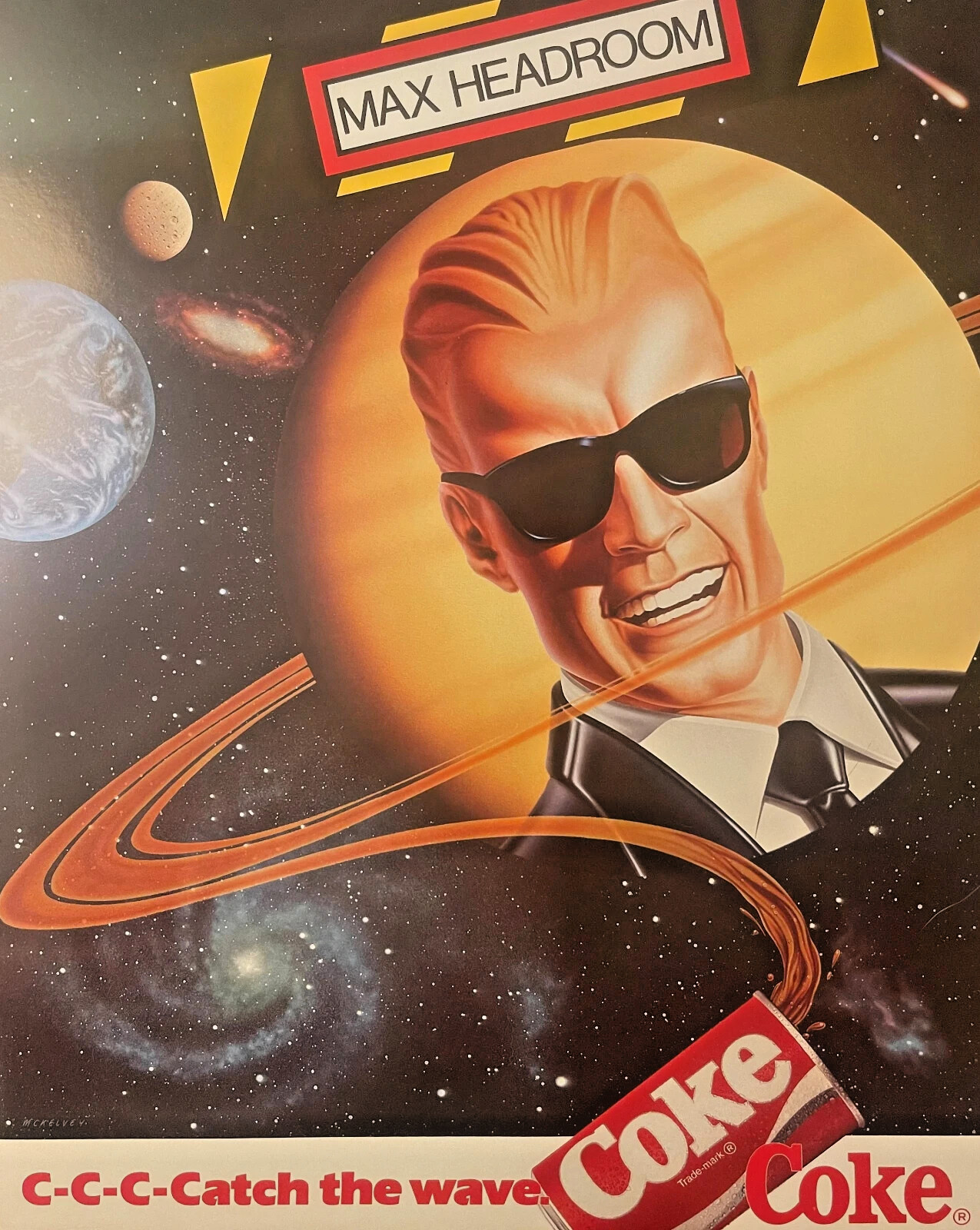
This is a vintage Coca-Cola advertising poster built around the Max Headroom character and the "Catch the Wave" campaign, produced in the classic offset lithograph process used for so much retail and point-of-sale advertising of its day. It measures 17 x 14 inches (43 x 36 cm) and comes to you as New Old Stock — meaning it was printed, warehoused, and never actually hung or handled for retail display, so what you're bringing home is a genuine unused survivor rather than something peeled off a store wall. The artwork itself is a full space-opera scene: Max's grinning, sunglassed head floats in the foreground against a glowing, ringed planet, with a distant blue Earth, a spiral galaxy, and a shooting star scattered through a star-flecked black sky, rendered in bold black, orange, yellow, red, white, and blue. A Coca-Cola can tilts at the bottom, pouring a ribbon of cola that curls upward and becomes the planet's rings — a clever bit of commercial illustration tying the drink physically into the cosmos around Max. Blocky red-and-yellow lettering across the top reads "MAX HEADROOM," while the bottom carries the campaign's signature stutter-slogan, "C-C-C-Catch the wave!", beside the Coca-Cola script and "Trade-mark" line. Down in the lower left corner, the artwork is signed "McKelvey" — a nice reminder that this mass-produced advertising piece began as original illustrated art, painted by a working commercial artist, not a photograph.
🥤 The Wildest Gamble in Soda HistoryTo understand why a stuttering TV character ended up hawking Coca-Cola, you have to go back to April 23, 1985 — the day The Coca-Cola Company did something it hadn't done in 99 years: it changed the formula of Coca-Cola itself. The project had a code name straight out of a spy novel, "Project Kansas," run in secret by marketing vice president Sergio Zyman and Coca-Cola USA president Brian Dyson. What followed was one of the most famous consumer backlashes in American retail history. Loyalists were furious, and just 79 days later, on July 11, 1985, the company brought back the original formula as "Coca-Cola classic," keeping the reformulated version on shelves alongside it simply as "Coca-Cola" — what most of the country still calls "New Coke" to this day.
With two colas now competing for attention, Coca-Cola split its advertising in two: "Red, White & You" carried the warm, patriotic pitch for Coca-Cola classic, while "Catch the Wave" was built to win back the youth market that had been drifting toward Pepsi. That's where Max came in. At the start of 1986, Coca-Cola's marketing team handed the "Catch the Wave" campaign to the buzzy, blazer-and-tie "computer-generated" TV personality played by actor Matt Frewer — swapping out a previous celebrity spokesman for a character built entirely out of 1980s techno-optimism.
🕶️ Max Headroom: The Character That Wasn't Real (Or Was He?)Max Headroom wasn't a Coca-Cola creation — he arrived fully formed from British television. He debuted on Channel 4 in the UK on April 4, 1985, in the TV movie Max Headroom: 20 Minutes Into the Future, created by video artists and directors George Stone, Annabel Jankel, and Rocky Morton, with a spinoff talk show following almost immediately after. He was marketed, quite convincingly for the era, as the first computer-generated TV presenter — a claim that fooled plenty of viewers who had no home computer to compare him to. In reality Max was actor Matt Frewer in prosthetic makeup and a molded plastic suit, shot in front of a blue screen, his stutter and pitch-bending warble added in post-production. Old-timers who watched him on TV in the mid-80s often insist to this day that they genuinely weren't sure at the time whether he was a real machine — that's how effective the illusion was.
For Coca-Cola, Max's crossover into American advertising was a genuine hit. Coverage from the period credited at least two of the "Catch the Wave" spots to director Ridley Scott — yes, the same Ridley Scott of Blade Runner and Alien — calling them some of the most cleverly structured advertising ever aimed at viewers under 30. Coca-Cola's own SVP of marketing at the time claimed that after the first wave of ads aired, 76 percent of teenagers already knew who Max was. The company's consumer hotline reportedly fielded more calls about Max than about any spokesperson before him — some callers apparently even wanting to know if he had a girlfriend. The campaign was recognized as one of the best television advertising efforts of 1986 by the industry trade press of the day.
🏛️ Atlanta, Georgia — Where the Syrup StartedEvery one of these posters, no matter how far it wanders in space-age imagery, traces back to one Atlanta afternoon: May 8, 1886, when pharmacist Dr. John Stith Pemberton mixed a syrup and carried it over to Jacobs' Pharmacy, where it sold for five cents a glass. It was Pemberton's bookkeeper, Frank M. Robinson, who suggested the name Coca-Cola and hand-lettered the flowing script still instantly recognizable on every can and bottle today. Pemberton sold off his interest before his death in 1888, and Atlanta businessman Asa Candler bought full control, formally founding The Coca-Cola Company in Atlanta in January 1892. The company has called Atlanta home ever since — meaning this poster, glowing with imagined planets and galaxies, is still, at its root, a direct descendant of a single Georgia pharmacy counter a century earlier.
🔥 Did Max Actually Save New Coke — and Why This Still MattersHere's the part collectors love telling: even with teenage America humming along to "catch the wave," Max Headroom couldn't fully rescue New Coke's reputation. Coca-Cola eventually phased the reformulated cola out, and Max's own television run wound down by the late 1980s, his moment in pop culture proving as brief and brilliant as it was strange. A decade later, in 1995, then-chairman Roberto Goizueta reflected candidly that the company had set out to change the dynamics of the cola market — and it had, "albeit not in the way we had planned" — calling the whole New Coke episode one of the most powerful signals in the brand's history. Today, marketing students and Coca-Cola collectors alike still point to the New Coke saga as the textbook case study in brand loyalty, and Max Headroom's brief, oddball tenure as Coke's spokes-character remains one of the most fondly remembered advertising curiosities to come out of it — a genuine piece of "future that never quite arrived" nostalgia that resonates just as strongly with retro-tech and cyberpunk collectors today as it does with Coca-Cola memorabilia hounds.
🖼️ Display Ideas- 🥤 Frame it for a home soda bar, bar cart, or retro kitchen corner alongside other Coca-Cola advertising pieces.
- 📺 Pair it with other 1980s pop culture and tech-nostalgia collectibles for a "future that never arrived" gallery wall.
- 🛰️ Let the space theme lead — hang it in a den or office alongside sci-fi and space-age memorabilia.
- 🎬 Perfect for fans of practical-effects TV and film history, celebrating an era before CGI took over.
- 🎁 A conversation-starting gift for the Coca-Cola collector or Gen-X nostalgia lover who actually remembers "New Coke."
- 🏢 Great for a retro-styled office, game room, or man cave that leans into bold 80s color and graphic design.
This piece sits right at the crossroads of several serious collecting worlds: dedicated Coca-Cola memorabilia collectors chasing campaign-specific advertising art, pop culture and TV history buffs tracking down anything tied to Max Headroom and the short-lived cyberpunk media moment he represented, and 1980s design enthusiasts drawn to the bold graphic sensibility of the era's advertising. It also appeals strongly to anyone who lived through the New Coke controversy firsthand and wants a genuine artifact of that strange 79-day chapter in American consumer history, as well as to displayers looking for a striking, colorful, conversation-piece poster rather than a plain vintage sign.
❓ FAQIs this an original advertising poster, or a modern reprint?
This is a genuine New Old Stock advertising poster from Coca-Cola's original "Catch the Wave" promotional run — never a modern reproduction.
What does "New Old Stock" mean here?
It means the poster was printed and set aside decades ago and never actually put up for retail display or use — it comes to you as an unused survivor straight from old inventory.
What size is the poster?
It measures 17 x 14 inches (43 x 36 cm).
Is this the same Max Headroom from the TV show?
Yes — this is the same character created for British television and played by Matt Frewer, licensed by Coca-Cola as the face of its "Catch the Wave" campaign.
Was this for regular Coca-Cola or "New Coke"?
This poster promoted Coca-Cola's reformulated cola (popularly called "New Coke"), which was marketed separately from Coca-Cola classic during the mid-1980s using this distinct "Catch the Wave" campaign.
Why did Coca-Cola choose Max Headroom as a spokesperson?
He replaced an earlier celebrity spokesperson as Coca-Cola pivoted to target younger drinkers who had been leaning toward competitors, betting on Max's buzzy "computer-generated" novelty to make Coke feel current again.
How old exactly is this poster?
There's no manufacture date printed on the piece itself, but it was produced during Coca-Cola's "Catch the Wave" campaign of the mid-1980s, the same run that famously used Max Headroom as its spokes-character.