


 On eBay Now...
VINTAGE GOLF CHAMPION PHOTO USED IN A BOOKVINTAGE GOLFER ORIGINAL HENRY COTTON For Sale
When you click on links to various merchants on this site and make a purchase, this can result in this site earning a commission. Affiliate programs and affiliations include, but are not limited to, the eBay Partner Network.

VINTAGE GOLF CHAMPION PHOTO USED IN A BOOKVINTAGE GOLFER ORIGINAL HENRY COTTON :
$293.80
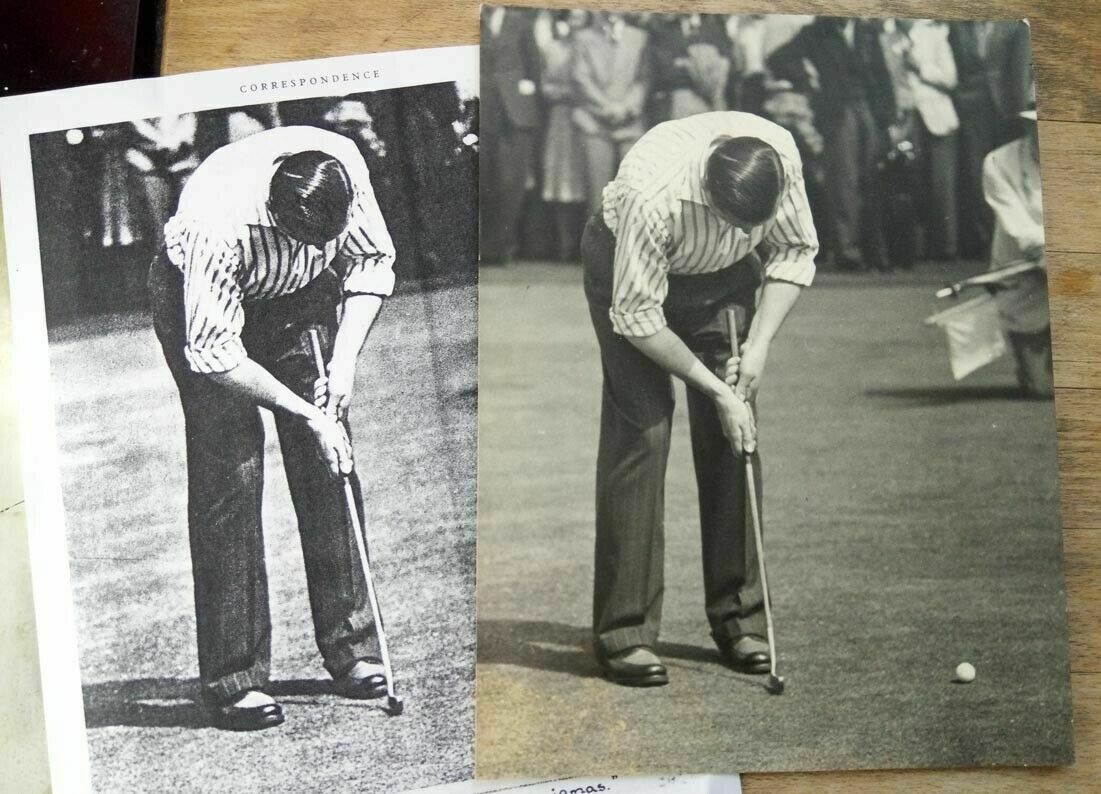
Vintage photo of Henry Cotton, golf, golfing, used in a book.Original item. Looks to have been used in a book about him (the photo is accompanied by a photocopy of what looks to be a book page). Approx 16 cm wide/across.From a collection of photos that belonged to Henry Cotton. Fine condition - see pics for more detail.many short trips across the channel to play in tournaments. By the beginning of 1937 he was ready to come back and Lord Rosebery, President of the five-year-old Ashridge club in Hertfordshire, persuaded him to become the club’s pro and, in Henry’s words, help them ‘get ahead’. His conditions of acceptance included being made an honorary member, almost unheard of then, and a new shop with showcases and fittings equal to anything in Bond Street, including Zebra-hide-covered seats and armchairs brought over from Waterloo. He even employed a full-time secretary to deal with his office work. He had a handsome house built in Ashridge Park, the former estate of the Duke of Bridgewater (the Canal Duke), which he named ‘Shangri-la’, after the valley in James Hilton’s book: The Lost Horizon.
Henry’s retainer was only £100 a year, which was about the same as mine at West Cheshire, but he was not ‘tied down’ at the club and he could charge at least £1 and up to £5 for a lesson against the ‘going rate’ of around 5s (25p) an hour. The club built a practise ground for him, with covered sheds for winter training. A round with Henry at Ashridge cost £10 and Clubs that invited him to play exhibition matches would pay him £300 for a single and £200 for a four-ball.
On Stage with Henry CottonIn 1938 he accepted an invitation to demonstrate his expertise in a fifteen minute stage act, which toured the country to packed houses and topped the bill at the Christmas Variety show at London’s Coliseum. Assisted by his caddie, Hargreaves, he took the audience through a beginner’s lesson and hit a variety of shots, finishing with a remarkable display of accuracy. People were asked to stand up in various parts of the auditorium and Henry landed balls into their hands. Hargreaves recalled in Caddie in the Golden Age that Henry was concerned during the second week when he heard that General Critchley had taken the first two rows of the stalls. The ‘General’ had a reputation as a hell-raiser and “…. As Henry had given him several thrashings at golf and fairly short shrift in conversation, the rumour around the theatre was that a collective ‘raspberry’ was in preparation”. He need not have worried, the anticipated heckling was lost in the cheers and the act went down even better that night. The white-headed driver he used in the act can be seen in the Golf Museum at St Andrews. Heading the supporting acts was Nellie Wallace: ‘The Quintessence of Quaintness’, whose song “My old Man said follow the van…” would be Henry’s cue to be ready in the wings. For the 16 week run Cotton received £10,000.
Henry was to be called upon to perform the act again in 1953, by Royal command, when he was invited to take part in Queen Elizabeth’s Command Performance. The act was as good as ever and ended triumphantly with a ball landing in the hands of a volunteer in the Royal Box – the Duke of Edinburgh, an honorary member of the R&A, but a non-golfer. His son Andrew was to be the only member of the family to follow in the footsteps of his great uncle and grandfather - Henry’s Royal pre-war partner, Edward V111 and his brother ‘Bertie’ - George V1 and become Captain of the R&A.
Incidentally, neither of the British Royal golfers ever played in competition as King. That distinction fell to King Leopold of the Belgians in 1939, when he became the first (and
The course once formed part of the Ashridge estate, ancient home of the Brownlow family. In days gone by, the park was one enormous forest in which the owners of the estate and their guests hunted for deer and other game. Herds of deer still roam the course whilst the old mansion is now a Management College.The original course architects were Major C K Hutchison, Sir Guy Campbell and Colonel S V Hotchkin who were careful to retain the essence of the stunning parkland with the result that every hole possesses the priceless attribute of unspoilt, natural beauty
Ashridge first came to prominence in the late 1930's following the appointment of Henry Cotton as resident Club Professional. Sir Henry Cotton, as he was to become, was arguably the best golfer of his era, winning three Open Championships including the Open at Carnoustie in 1937 whilst he was at Ashridge. In fact, in that year Sir Henry's two Assistants, Bill Laidlaw and Fred Robertson, finished 7th and 18th respectively, the only occasion during the last 100 years when three representatives of the same Club finished so high in the order.
Full membership is currently limited to 468, to ensure that members have ready access to the course. We are a club owned by the members and run for the benefit of the members. Our vision is to be a great members’ golf club with excellent facilities, that is financially sound and which aspires to be consistently included as one of the top 100 golf clubs in the UK.
A few vacancies do arise every year, though, and we are always interested in meeting prospective new members, male and female, of all golfing abilities.
Rob Smith, a contributing editor for Golf Monthly, recently wrote…
‘It is often hard to summarise a course and indeed a club in one sentence, but I will attempt to do so by saying simply this – that if I lived in the area, this is the club I would aspire to join.’
Sir Thomas Henry Cotton, MBE (26 January 1907 – 22 December 1987), was an English professional golfer known for winning three Open Championships.
Cotton started his career as a professional golfer at the age of 17 when he joined his younger brother Leslie as assistant teaching professional at Fulwell Golf Club under Fulwell's professional, George Oke, who had been at Honor Oak until 1921.[2][3][4]
Cotton was known for working extremely hard at his game, often practising until his hands bled. Cotton placed great emphasis upon accuracy and differed from modern golf teachers in the great emphasis he placed upon the role of the hands in the golf swing. Although emphasis was given to a correct grip, he also emphasised the need to build up the strength of the hands and forearms. The competition golfer, equipped with such assets could counter an off centre strike off the face of the club and still achieve a powerful, yet accurate shot. He also stated the need to "educate the hands" in that the competitive golfer had to achieve an awareness of the position of the hands during the golf swing itself, something modern teachers have not stressed greatly, preferring a more passive role for the hands.[citation needed]
He achieved fame during the 1930s and 1940s, with three victories in The Open Championship (1934, 1937, and 1948). His record round of 65, made during the 1934 Open Championship, led to the Dunlop golf company issuing the famous 'Dunlop 65' ball. Cotton placed 17 times in the top-10 at the Open. Cotton also succeeded in winning many titles on the European circuit during the 1930s. During this period he was a professional at the Ashridge Golf Club.[citation needed]
During World War II he served with the Royal Air Force, and raised money for the Red Cross by playing exhibition matches and shows. This earned him an MBE. At this time he was stationed at RAF Halton and was closely involved with what is now the Chiltern Forest Golf club. He added three holes to the course (taking it from 6 to 9) and made other improvements.[citation needed]
Cotton was a member of four British Ryder Cup teams, and served as captain of the team in 1947 and 1953. He competed only occasionally in the United States, without notable success.
ir Thomas Henry Cotton, MBE (28 January 1907 – 22 December 1987) was an English professional golfer. He won the Open Championship in 1934, 1937 and 1948, becoming the leading British player of his generation.[1]The Rookie of the Year award in European Tour is named after him.Contents1 Early life2 Career3 Personal life and retirement4 Tournament wins (37)4.1 Important wins (30)4.2 Other wins (7)5 Major championships5.1 Wins (3)5.2 Results timeline6 Team appearances7 Gallery8 References9 External linksEarly lifeCotton was born in Holmes Chapel, then known as Church Hulme, near Congleton, Cheshire on 28 January 1907.[2] He had an older brother, Leslie (born 1905), who also became a professional golfer. Cotton was brought up in Crystal Palace Road, East Dulwich, London. He later went to Reigate Grammar School, and then won a scholarship to Alleyn's School in Dulwich, South London.[2] He was a useful cricketer, good enough to bat at number 3 for the school against Surrey Club and Ground, a team containing 5 professionals, at the age of 15.[3] Cotton and his brother had already taken up a second sport, golf, at the Aquarius Golf Club in Honor Oak from 1920.[4] In September 1921 the Cotton brothers played in the first Boys Amateur Championship, then limited to boys under 16. Henry played the eventual winner, Donald Mathieson, on the first day, losing by 2 holes,[5] Cotton was all square after 16 holes but lost the 17th after being incorrectly penalised for placing his bag in a bunker.[6] Cotton also played in the 1922 Boys Championship, again losing in the first round.[7] In June 1923 Cotton won the Hutchings Trophy, the Championship of the Aquarius Club.[4]
CareerCotton left school in the summer of 1923 and soon started his career as a professional golfer, joining his older brother Leslie as assistant teaching professional at Fulwell Golf Club under Fulwell's professional, George Oke, who had been at Honor Oak since 1921.[4][8][9] Within a year Cotton had left and become an assistant at Rye Golf Club near Rye, East Sussex.[2] During his time at Rye, Cotton travelled to Scotland to try to qualify for the 1925 Open Championship. However scores of 85 and 82 left him well outside the qualifying mark of 158.[10] In March 1926, aged 19, he became the professional at Langley Park Golf Club near Beckenham in Kent, replacing Frank Ball who emigrated to America later the same year.[11]
Cotton remained at Langley Park until the end of 1932 when he moved to the Waterloo Golf Club near Brussels, Belgium. While there, Cotton improved his game and by the time he left he was one of Britain's leading golfers. In 1926, Cotton again failed to qualifying for the Open Championship but later in the year qualified for the knock-out stages of the Yorkshire Evening News Tournament and the News of the World Match Play and ended the season by winning the Kent Professional Championship.[12]Cotton training as a pilot at Croydon Airport in 1930He achieved fame during the 1930s and 1940s, with three victories in The Open Championship (1934, 1937, and 1948). His record round of 65, made during the 1934 Open Championship, led to the Dunlop golf company issuing the famous 'Dunlop 65' ball. Cotton placed 17 times in the top-10 at the Open. Cotton also succeeded in winning many titles on the European circuit during the 1930s. During this period he was a professional at the Ashridge Golf Club.[citation needed]
Cotton was trained as a pilot since at least 1930.[13] During World War II he served with the Royal Air Force, and raised money for the Red Cross by playing exhibition matches and shows. This earned him an MBE. At this time he was stationed at RAF Halton and was closely involved with what is now the Chiltern Forest Golf club. He added three holes to the course (taking it from six to nine) and made other improvements.[citation needed]
Cotton was a playing member of three British Ryder Cup teams, in 1929, 1937 and 1947, serving as captain of the team in 1947, and was a non-playing captain in 1953. He competed only occasionally in the United States, without notable success.[14]
Personal life and retirement
Cotton and Toots are getting married on 11 December 1939On 11 December 1939[15] Cotton married Isabel-Maria Estanguet de Moss, the daughter of a Buenos Aires beef merchant, who was taking golf lessons from Cotton and was known by her nickname 'Toots'. She supported Cotton during his golf competitions and affected the way he would dress for them.[16]
Following his retirement from competitive golf in the early 1950s, Cotton became a successful architect of golf courses, including designing the Penina Golf and Resort and Pestana Alto Golf on the Algarve, Portugal.[17] He was hired by Baron Edmond Adolphe de Rothschild to design the golf course in Megève, Haute-Savoie, France.[18] Cotton wrote 10 books, and established the Golf Foundation, which helped thousands of young boys and girls get started in golf.[citation needed]
Cotton loved the high life, including champagne, caviar and bespoke tailored clothes. He lived for a while in a suite in a 5-star hotel, and later bought an estate complete with butler and full staff, travelling everywhere in a Rolls-Royce.[citation needed]
Cotton was inducted into the World Golf Hall of Fame in 1980. He was knighted in the New Year's Day Honours of 1988, named a Knight Bachelor.[19] This was reported in some media as a "posthumous knighthood" because he had died by the time it was publicly announced. However, the Queen had approved the award and he had accepted it, before his death.[20]
Tournament wins (37)Important wins (30)Date Tournament Venue Winning score Margin ofvictory Runner(s)-up29 Jun 1930 Belgian Open Royal Golf Club of Belgium 73-68-74-66=281 11 strokes England Archie Compston15 May 1931 Dunlop-Southport Tournament Southport and Ainsdale Golf Club 70-77-68-72=287 2 strokes England Archie Compston14 May 1932 Dunlop-Southport Tournament Hesketh Golf Club 68-69-72-72=281 Playoff England Bill Twine23 Sep 1932 News of the World Match Play Moor Park Golf Club 10 & 8 in final England Alf Perry29 Jun 1934 The Open Championship Royal St George's Golf Club 67-65-72-79=283 5 strokes South Africa Sid Brews14 Aug 1934 Belgian Open Royal Waterloo Golf Club 67-71-73-68=279 3 strokes England Percy Alliss8 Jun 1935 Yorkshire Evening News Tournament Sand Moor Golf Club 3 & 2 in final England Percy Alliss3 Aug 1936 Italian Open Sestrieres Golf Club 68-67-67-66=268 6 strokes United States Joe Ezar24 Sep 1936 Dunlop-Metropolitan Tournament Wentworth Club 72-68-70-71=281 3 strokes England Arthur Lacey, England Reg Whitcombe23 Apr 1937 Silver King Tournament Moor Park Golf Club 73-68-70-68=279 1 stroke Republic of Ireland Paddy Mahon9 Jul 1937 The Open Championship Carnoustie Golf Links 74-72-73-71=290 2 strokes England Reg Whitcombe15 Aug 1937 German Open Bad Ems Golf Club 63-70-69-72=274 17 strokes France Auguste Boyer21 Aug 1937 Czechoslovak Open Marienbad Golf Club 70-72-69-68=279 5 strokes England Arthur Lees13 Jul 1938 Belgian Open Royal Waterloo Golf Club 66-70-69-72=277 13 strokes England Arthur Lacey21 Aug 1938 German Open Frankfurter Golf Club 71-68-70-76=285 15 strokes England Arthur Lees26 Aug 1938 Czechoslovak Open Carlsbad Golf Club 71-67-72-72=282 11 strokes Scotland Bill Laidlaw1 Apr 1939 Daily Mail Tournament Queens Park Golf Club 69-75-77-71=292 Playoff England Archie Compston17 Jun 1939 Penfold Professional Golf League Little Aston Golf Club 18 points Tie England Charles Whitcombe20 Aug 1939 German Open Bad Ems Golf Club 67-71-72-70=280 11 strokes Germany Georg Bessner3 May 1940 News of the World Match Play Royal Mid-Surrey Golf Club 37th hole in final England Alf Padgham24 Aug 1945 News Chronicle Tournament Hollingbury Park Golf Club 74-77-76-74=301 4 strokes England Percy Alliss, England Arthur Havers27 Apr 1946 The Star Tournament Wentworth Club 4 & 3 in final England Arthur Lees11 Jul 1946 French Open Saint-Cloud Golf Club 70-66-67-66=269 15 strokes Belgium Flory Van Donck28 Sep 1946 News of the World Match Play Royal Liverpool Golf Club 8 & 7 in final Scotland Jimmy Adams6 Jun 1947 Spalding Tournament Old Course at St Andrews 74-69-71-74=288 5 strokes Wales Dai Rees13 Jun 1947 Yorkshire Evening News Tournament Moortown Golf Club 66-72-70-69=277 Tie Australia Norman Von Nida16 Jul 1947 French Open Chantilly Golf Club 68-71-73-73=285 3 strokes England John Knipe2 Jul 1948 The Open Championship Muirfield 71-66-75-72=284 5 strokes Northern Ireland Fred Daly13 Jun 1953 Dunlop Tournament Wentworth Club 72-65-70-72-74=353 5 strokes Wales Dai Rees22 May 1954 Penfold Tournament Maesdu Golf Club 5 & 4 in final England John JacobsOther wins (7)Note: This list may be incomplete.
1926 Kent Professional Championship1927 Kent Professional Championship1928 Kent Professional Championship1929 Kent Professional Championship1930 South Open (Argentina), Kent Professional Championship1948 White Sulphur Springs Tournament (USA)Major championshipsWins (3)Year Championship 54 holes Winning score Margin Runner-up1934 The Open Championship 10 shot lead 67-65-72-79=283 5 strokes South Africa Sid Brews1937 The Open Championship (2) 3 shot deficit 74-72-73-71=290 2 strokes England Reg Whitcombe1948 The Open Championship (3) 2 shot lead 71-66-75-72=284 5 strokes Northern Ireland Fred DalyResults timelineTournament 1927 1928 1929Masters Tournament NYF NYF NYFU.S. Open The Open Championship 9 T18 T32Tournament 1930 1931 1932 1933 1934 1935 1936 1937 1938 1939Masters Tournament NYF NYF NYF NYF U.S. Open CUT The Open Championship 8 T10 T10 T7 1 T7 T3 1 3 T13Tournament 1940 1941 1942 1943 1944 1945 1946 1947 1948 1949Masters Tournament NT NT NT T25 U.S. Open NT NT NT NT The Open Championship NT NT NT NT NT NT T4 T6 1 Tournament 1950 1951 1952 1953 1954 1955 1956 1957 1958 1959Masters Tournament T68 T13 U.S. Open T17 The Open Championship 4 CUT T32 T6 T9 T8 T41Tournament 1960 1961 1962 1963 1964 1965 1966 1967 1968 1969Masters Tournament U.S. Open The Open Championship T32 Tournament 1970 1971 1972 1973 1974 1975 1976 1977Masters Tournament U.S. Open The Open Championship CUTNote: Cotton never played in the PGA Championship. Win Top 10 Did not playNYF = Tournament not yet foundedNT = No tournamentCUT = missed the half-way cut"T" indicates a tie for a place
Team appearancesRyder Cup (representing Great Britain): 1929 (winners), 1937, 1947 (captain), 1953 (non-playing captain)Seniors vs Juniors (representing the Juniors): 1928France–Great Britain Professional Match (representing Great Britain): 1929 (winners)Coronation Match (representing the Ladies and Professionals): 1937Joy Cup (representing the British Isles): 1954 (winners, captain), 1955 (winners, non-playing captain), 1956 (winners, captain)
IR HENRY COTTON“Maestro.”
There was a style and substance about Sir Henry Cotton that made him not only unique, but a British national hero. He was much more than just a three-time British Open champion. He also championed the cause of British golf professionals seeking a higher ground in their country’s society and became a patriarch of the European Golf Tour. Described as witty, handsome, intelligent, urbane and a non-conformist, Cotton authored 10 books, designed golf courses and was the most respected and prolific British instructor of his era. His philosophy was simple: “To be a champion, you must act like one.”
Quote"To be a champion, you must act like one."Cotton was born Jan. 26, 1907, at Holmes Chapel in Cheshire, England. He left private school at age 16 in a dispute with his cricket coach and set out to learn the trade of golf on his own terms. This meant dressing smartly but shunning the traditional jacket and tie, and behaving properly, but never subserviently. Encouraged by Harry Vardon, James Braid and J.H. Taylor, Cotton took his first head professional job three years later, but soon moved to the Waterloo Club in Brussels, where he was treated as an equal.
Cotton’s devotion to practice was almost maniacal for he believed the only secrets to becoming a champion golfer were hard work and strong hands. For hours upon hours, Cotton was known to hit balls from thick rough until his hands blistered and bled. It was an obsession that paid off in the 1934 Open at Royal St. George’s. With opening rounds of 67-65–132, Cotton set two scoring records and opened a lead that was insurmountable. Even with a 79 in the final round, Cotton was able to win by five strokes and end a run of overseas victors that had lasted since Arthur Havers’ triumph in 1923.
Cotton’s second Open Championship triumph came three years later at Carnoustie, where his final round of 71, shot in a downpour, was considered every bit as good as his record 65. That gave Cotton a two-stroke victory against a field that included every member of a United States Ryder Cup team captained by Walter Hagen which included Gene Sarazen, Byron Nelson, Sam Snead, Ralph Guldahl, Denny Shute and Henry Picard.
FACT
Sir Henry Cotton is considered the first British player who put himself through a rigorous practice schedule.
In addition to those popular victories, Cotton also won three British Match Play Championships and 11 national championships on the continent of Europe. He played for his country in three Ryder Cup matches and twice captained the British team, but most of his time after the 1948 Open Championship at Muirfield was dedicated to instruction, designing golf courses and giving back to the game that had given so much to him.
Whether it was giving no-cost instruction to junior golfers through the Golf Foundation, or doing exhibitions to raise money for the Red Cross, Henry Cotton was as hard-working and devoted as he had been about learning how to swing a golf club. For this, he was honored with a Knighthood, and on New Year’s Day of 1988, just one week after his death, Henry Cotton MBE officially became Sir Henry Cotton, Knight Commander of the Most Honourable Order of St. Michael and St. George.
It was his third Open Championship at Muirfield in 1948 that completed Cotton’s transformation from the anti-establishment rebel to a national sporting legend and celebrity. Now 41 and robbed of his prime by World War II, Cotton shot a course-record 66 in the second round that was witnessed by King George VI. It was the only time a reigning monarch had been present at the Open.
Henry Cotton, MBE.The public schoolboy who changed the face ofprofessional golf.Barred from a clubhouse, he picknicked from the bootof his Rolls Royce out of a hamper from Fortnum& Masons.Married to an Argentinian heiress Sir Henry Cottonlived life as he loved it - luxuriously and to the full.Friend of Kings, partner to Princes, no one has donemore to bring the game within reach of all levels ofsociety.Ryder Cup:Three appearances1929 - Moortown1937 - Southport1947 - Portland, OregonNon-playing Captain:1953 WentworthHon Member of theRoyal & AncientCaptain of P.G.A.1934-48Founder Member of theGolf FoundationAwarded:Harry Vardon Trophy 1938Walter Hagen Award 1979Seventeen holes in oneduring his competitiveplaying careerHad the Dunlop 65 golf ballnamed in honour of his roundof 65 in the Open atRoyal St. Georges in 1934The year ended sadly with thedeath of one of golf's greatestcharacters, Thomas HenryCotton, a month short of his81st birthday.Controversial to the very end,Henry will no doubt revel in hislast poser to officialdom,whether he will in future bereferred to as "the late Sir HenryCotton" or just plain HenryCotton MBE. At least the longawaited recognition was given tohim and he knew a month beforehe died.No man gave more or foughtharder for the professional gameand this applies not only togolfers but greenkeepers as well.Latterly, his playing days over,he took an increasing interest incourse design and maintenanceand was a regular visitor to newconstructions and irrigationschemes all over the country,discussing with a considerabledepth of knowledge the needs ofthe greenkeeper. Althoughspending winters at his belovedPenina, Henry made England hishome for the summer to attendthe Open Championship and TestMatches at the Oval and Lords.In between he squeezed in hispersonal appearances, usually fora fat fee - and who can blamehim!The stories of Cotton arelegendary and no doubt someoneis already compiling a best sellerof his life interspersed with ahost of anecdotes. A conversationwith Cotton was invariably oneway - he spoke and you listened,but it was never boring, alwaysinformative.Henry was a regular reader ofthis publication and only shortlybefore his untimely death wrotea short note to say how much heenjoyed receiving his copy askingfor it to be redirected to hisLondon address.If one may be permitted apersonal recollection it will bethe advice he offered whendiscussing how to play a hole atthe Berkshire. "Don't try anythingfancy, my boy. Keep the ball onthe cut grass - you are lesslikely to get into trouble".Such philosophy could beregarded as sound advice inmany fields other than golf.Thomas Henry CottonBorn at Holmes Chapel,Cheshire26th January, 1907Open Champion:1934 Royal St. Georges,Sandwich1937 Carnoustie1948 MuirfieldWinner:Belgian Open 1930-34-38Italian Open 1936German Open 1936-37-38-39French Open 1946-47Argentine Open 1930Sir Thomas Henry Cotton, MBE (28 January 1907 – 22 December 1987) was an English professional golfer. He won the Open Championship in 1934, 1937 and 1948, becoming the leading British player of his generation.[1] The Rookie of the Year award in European Tour is named after him.Contents1 Early life2 Career3 Personal life and retirement4 Tournament wins (37)4.1 Important wins (30)4.2 Other wins (7)5 Major championships5.1 Wins (3)5.2 Results timeline6 Team appearances7 Gallery8 References9 External linksEarly lifeCotton was born in Holmes Chapel, then known as Church Hulme, near Congleton, Cheshire on 28 January 1907.[2] He had an older brother, Leslie (born 1905), who also became a professional golfer. Cotton was brought up in Crystal Palace Road, East Dulwich, London. He later went to Reigate Grammar School, and then won a scholarship to Alleyn's School in Dulwich, South London.[2] He was a useful cricketer, good enough to bat at number 3 for the school against Surrey Club and Ground, a team containing 5 professionals, at the age of 15.[3] Cotton and his brother had already taken up a second sport, golf, at the Aquarius Golf Club in Honor Oak from 1920.[4] In September 1921 the Cotton brothers played in the first Boys Amateur Championship, then limited to boys under 16. Henry played the eventual winner, Donald Mathieson, on the first day, losing by 2 holes,[5] Cotton was all square after 16 holes but lost the 17th after being incorrectly penalised for placing his bag in a bunker.[6] Cotton also played in the 1922 Boys Championship, again losing in the first round.[7] In June 1923 Cotton won the Hutchings Trophy, the Championship of the Aquarius Club.[4]
CareerCotton left school in the summer of 1923 and soon started his career as a professional golfer, joining his older brother Leslie as assistant teaching professional at Fulwell Golf Club under Fulwell's professional, George Oke, who had been at Honor Oak since 1921.[4][8][9] Within a year Cotton had left and become an assistant at Rye Golf Club near Rye, East Sussex.[2] During his time at Rye, Cotton travelled to Scotland to try to qualify for the 1925 Open Championship. However scores of 85 and 82 left him well outside the qualifying mark of 158.[10] In March 1926, aged 19, he became the professional at Langley Park Golf Club near Beckenham in Kent, replacing Frank Ball who emigrated to America later the same year.[11]
Cotton remained at Langley Park until the end of 1932 when he moved to the Waterloo Golf Club near Brussels, Belgium. While there, Cotton improved his game and by the time he left he was one of Britain's leading golfers. In 1926, Cotton again failed to qualifying for the Open Championship but later in the year qualified for the knock-out stages of the Yorkshire Evening News Tournament and the News of the World Match Play and ended the season by winning the Kent Professional Championship.[12]Cotton training as a pilot at Croydon Airport in 1930He achieved fame during the 1930s and 1940s, with three victories in The Open Championship (1934, 1937, and 1948). His record round of 65, made during the 1934 Open Championship, led to the Dunlop golf company issuing the famous 'Dunlop 65' ball. Cotton placed 17 times in the top-10 at the Open. Cotton also succeeded in winning many titles on the European circuit during the 1930s. During this period he was a professional at the Ashridge Golf Club.[citation needed]
Cotton was trained as a pilot since at least 1930.[13] During World War II he served with the Royal Air Force, and raised money for the Red Cross by playing exhibition matches and shows. This earned him an MBE. At this time he was stationed at RAF Halton and was closely involved with what is now the Chiltern Forest Golf club. He added three holes to the course (taking it from six to nine) and made other improvements.[citation needed]
Cotton was a playing member of three British Ryder Cup teams, in 1929, 1937 and 1947, serving as captain of the team in 1947, and was a non-playing captain in 1953. He competed only occasionally in the United States, without notable success.[14]
Personal life and retirement
Cotton and Toots were married on 11 December 1939On 11 December 1939[15] Cotton married Isabel-Maria Estanguet de Moss, the daughter of a Buenos Aires beef merchant, who was taking golf lessons from Cotton and was known by her nickname 'Toots'. She supported Cotton during his golf competitions and affected the way he would dress for them.[16]
Following his retirement from competitive golf in the early 1950s, Cotton became a successful architect of golf courses, including designing the Penina Golf and Resort and Pestana Alto Golf on the Algarve, Portugal.[17] He was hired by Baron Edmond Adolphe de Rothschild to design the golf course in Megève, Haute-Savoie, France.[18] Cotton wrote 10 books, and established the Golf Foundation, which helped thousands of young boys and girls get started in golf.[citation needed]
Cotton loved the high life, including champagne and bespoke tailored clothes. He lived for a while in a suite in a 5-star hotel, and later bought an estate complete with butler and full staff, traveling everywhere in a Rolls-Royce.[citation needed] Cotton stated in his book "This Game Of Golf" that his hero was Walter Hagen who was a flashy dresser and a high-roller. Cotton marveled at how Hagen would stay up all night playing cards for money on the eve of a tournament and how Hagen would go straight to the first tee without even warming up beforehand..
Cotton was inducted into the World Golf Hall of Fame in 1980. He was knighted in the New Year's Day Honours of 1988, named a Knight Bachelor.[19] This was reported in some media as a "posthumous knighthood" because he had died by the time it was publicly announced. However, the Queen had approved the award and he had accepted it, before his death.[20]
Tournament wins (37)Important wins (30)Date Tournament Venue Winning score Margin ofvictory Runner(s)-up29 Jun 1930 Belgian Open Royal Golf Club of Belgium 73-68-74-66=281 11 strokes England Archie Compston15 May 1931 Dunlop-Southport Tournament Southport and Ainsdale Golf Club 70-77-68-72=287 2 strokes England Archie Compston14 May 1932 Dunlop-Southport Tournament Hesketh Golf Club 68-69-72-72=281 Playoff England Bill Twine23 Sep 1932 News of the World Match Play Moor Park Golf Club 10 & 8 in final England Alf Perry29 Jun 1934 The Open Championship Royal St George's Golf Club 67-65-72-79=283 5 strokes South Africa Sid Brews14 Aug 1934 Belgian Open Royal Waterloo Golf Club 67-71-73-68=279 3 strokes England Percy Alliss8 Jun 1935 Yorkshire Evening News Tournament Sand Moor Golf Club 3 & 2 in final England Percy Alliss3 Aug 1936 Italian Open Sestrieres Golf Club 68-67-67-66=268 6 strokes United States Joe Ezar24 Sep 1936 Dunlop-Metropolitan Tournament Wentworth Club 72-68-70-71=281 3 strokes England Arthur Lacey, England Reg Whitcombe23 Apr 1937 Silver King Tournament Moor Park Golf Club 73-68-70-68=279 1 stroke Republic of Ireland Paddy Mahon9 Jul 1937 The Open Championship Carnoustie Golf Links 74-72-73-71=290 2 strokes England Reg Whitcombe15 Aug 1937 German Open Bad Ems Golf Club 63-70-69-72=274 17 strokes France Auguste Boyer21 Aug 1937 Czechoslovak Open Marienbad Golf Club 70-72-69-68=279 5 strokes England Arthur Lees13 Jul 1938 Belgian Open Royal Waterloo Golf Club 66-70-69-72=277 13 strokes England Arthur Lacey21 Aug 1938 German Open Frankfurter Golf Club 71-68-70-76=285 15 strokes England Arthur Lees26 Aug 1938 Czechoslovak Open Carlsbad Golf Club 71-67-72-72=282 11 strokes Scotland Bill Laidlaw1 Apr 1939 Daily Mail Tournament Queens Park Golf Club 69-75-77-71=292 Playoff England Archie Compston17 Jun 1939 Penfold Professional Golf League Little Aston Golf Club 18 points Tie England Charles Whitcombe20 Aug 1939 German Open Bad Ems Golf Club 67-71-72-70=280 11 strokes Germany Georg Bessner3 May 1940 News of the World Match Play Royal Mid-Surrey Golf Club 37th hole in final England Alf Padgham24 Aug 1945 News Chronicle Tournament Hollingbury Park Golf Club 74-77-76-74=301 4 strokes England Percy Alliss, England Arthur Havers27 Apr 1946 The Star Tournament Wentworth Club 4 & 3 in final England Arthur Lees11 Jul 1946 French Open Saint-Cloud Golf Club 70-66-67-66=269 15 strokes Belgium Flory Van Donck28 Sep 1946 News of the World Match Play Royal Liverpool Golf Club 8 & 7 in final Scotland Jimmy Adams6 Jun 1947 Spalding Tournament Old Course at St Andrews 74-69-71-74=288 5 strokes Wales Dai Rees13 Jun 1947 Yorkshire Evening News Tournament Moortown Golf Club 66-72-70-69=277 Tie Australia Norman Von Nida16 Jul 1947 French Open Chantilly Golf Club 68-71-73-73=285 3 strokes England John Knipe2 Jul 1948 The Open Championship Muirfield 71-66-75-72=284 5 strokes Northern Ireland Fred Daly13 Jun 1953 Dunlop Tournament Wentworth Club 72-65-70-72-74=353 5 strokes Wales Dai Rees22 May 1954 Penfold Tournament Maesdu Golf Club 5 & 4 in final England John JacobsOther wins (7)Note: This list may be incomplete.
1926 Kent Professional Championship1927 Kent Professional Championship1928 Kent Professional Championship1929 Kent Professional Championship1930 South Open (Argentina), Kent Professional Championship1948 White Sulphur Springs Tournament (USA)Major championshipsWins (3)Year Championship 54 holes Winning score Margin Runner-up1934 The Open Championship 10 shot lead 67-65-72-79=283 5 strokes South Africa Sid Brews1937 The Open Championship (2) 3 shot deficit 74-72-73-71=290 2 strokes England Reg Whitcombe1948 The Open Championship (3) 2 shot lead 71-66-75-72=284 5 strokes Northern Ireland Fred DalyResults timelineTournament 1927 1928 1929Masters Tournament NYF NYF NYFU.S. Open The Open Championship 9 T18 T32Tournament 1930 1931 1932 1933 1934 1935 1936 1937 1938 1939Masters Tournament NYF NYF NYF NYF U.S. Open CUT The Open Championship 8 T10 T10 T7 1 T7 T3 1 3 T13Tournament 1940 1941 1942 1943 1944 1945 1946 1947 1948 1949Masters Tournament NT NT NT T25 U.S. Open NT NT NT NT The Open Championship NT NT NT NT NT NT T4 T6 1 Tournament 1950 1951 1952 1953 1954 1955 1956 1957 1958 1959Masters Tournament T68 T13 U.S. Open T17 The Open Championship 4 CUT T32 T6 T9 T8 T41Tournament 1960 1961 1962 1963 1964 1965 1966 1967 1968 1969Masters Tournament U.S. Open The Open Championship T32 Tournament 1970 1971 1972 1973 1974 1975 1976 1977Masters Tournament U.S. Open The Open Championship CUTNote: Cotton never played in the PGA Championship. Win Top 10 Did not playNYF = Tournament not yet foundedNT = No tournamentCUT = missed the half-way cut"T" indicates a tie for a place
Team appearancesRyder Cup (representing Great Britain): 1929 (winners), 1937, 1947 (captain), 1953 (non-playing captain)Seniors vs Juniors (representing the Juniors): 1928France–Great Britain Professional Match (representing Great Britain): 1929 (winners)Coronation Match (representing the Ladies and Professionals): 1937Joy Cup (representing the British Isles): 1954 (winners, captain), 1955 (winners, non-playing captain), 1956 (winners, captain)Gallery
Leslie and Henry Cotton (right) at a Boys Golf Championship in 1921Cotton after winning the Pilling Challenge Cup in 1923Cotton after winning the Open in Carnoustie in 1937
Sir Henry Cotton, in full Sir Thomas Henry Cotton, (born January 26, 1907, Holmes Chapel, Cheshire, England—died December 22, 1987, London), preeminent British golfer in the decades following World War I.
Golf putter hitting golf tee and ball. (game; sport; golf ball; golf club)BRITANNICA QUIZA Hole in OneFrom its country of origin to its various clubs and obstacles, take a swing at this quiz and learn more about the sport of golf.Cotton was encouraged by his father to play golf, and, after being coached by John Henry Taylor, he became a full-time professional golfer in 1926. His first win of the Open Championship (British Open) in 1934 ended a decade of American victories in that major tournament. He won the tournament again in 1937 and 1948. He also won 11 European Open championships, and he represented Great Britain in Ryder Cup competition four times.
Conspicuously ambitious and intelligent, Cotton was a compelling personality who contributed enormously to elevating the status of the professional golfer in Great Britain. After his retirement he taught and wrote numerous books and articles on golf, including Studying the Golf Game (1964), A History of Golf (1973), and Thanks for the Game (1980). He was awarded a knighthood posthumously.Golf is a club-and-ball sport in which players use various clubs to hit balls into a series of holes on a course in as few strokes as possible.
Golf, unlike most ball games, cannot and does not utilize a standardized playing area, and coping with the varied terrains encountered on different courses is a key part of the game. The game at the usual level is played on a course with an arranged progression of 18 holes, though recreational courses can be smaller, often having nine holes. Each hole on the course must contain a teeing ground to start from, and a putting green containing the actual hole or cup 4+1⁄4 inches (11 cm) in diameter. There are other standard forms of terrain in between, such as the fairway, rough (long grass), bunkers (or "sand traps"), and various hazards (water, rocks) but each hole on a course is unique in its specific layout and arrangement.
Golf is played for the lowest number of strokes by an individual, known as stroke play, or the lowest score on the most individual holes in a complete round by an individual or team, known as match play. Stroke play is the most commonly seen format at all levels, but most especially at the elite level.
The modern game of golf originated in 15th century Scotland. The 18-hole round was created at the Old Course at St Andrews in 1764. Golf's first major, and the world's oldest tournament in existence, is The Open Championship, also known as the British Open, which was first played in 1860 at the Prestwick Golf Club in Ayrshire, Scotland. This is one of the four major championships in men's professional golf, the other three being played in the United States: The Masters, the U.S. Open, and the PGA Championship.Contents1 Origin and history2 Golf course3 Play of the game4 Rules and regulations4.1 Penalties5 Equipment6 Stroke mechanics6.1 Stance6.2 Strokes6.3 Musculature6.4 Types of putting7 Scoring and handicapping7.1 Par7.1.1 Scoring7.2 Basic forms of golf7.2.1 Match play7.2.2 Stroke play7.3 Other formats of play7.3.1 Bogey or par competition7.3.2 Stableford7.3.3 Basic pairs formats7.3.4 Team formats7.4 Handicap systems8 Popularity8.1 Golf courses worldwide9 Professional golf9.1 Instruction9.2 Golf tours9.3 Men's major championships9.4 Women's major championships9.5 Senior major championships9.6 Olympic Games10 Women11 International events12 See also13 References14 External linksOrigin and historyMain article: History of golf
The Xuande Emperor of the Ming dynasty playing chuiwanWhile the modern game of golf originated in 15th century Scotland, the game's ancient origins are unclear and much debated.
Some historians[3] trace the sport back to the Roman game of paganica, in which participants used a bent stick to hit a stuffed leather ball. One theory asserts that paganica spread throughout Europe as the Romans conquered most of the continent, during the first century BC, and eventually evolved into the modern game.[4]
Others cite chuiwan (捶丸; "chui" means striking and "wan" means small ball)[5] as the progenitor, a Chinese game played between the eighth and fourteenth centuries.[6] A Ming Dynasty scroll by the artist Youqiu dating back to 1368 entitled "The Autumn Banquet" shows a member of the Chinese Imperial court swinging what appears to be a golf club at a small ball with the aim of sinking it into a hole.[5] The game is thought to have been introduced into Europe during the Middle Ages.[7]The MacDonald boys playing golf, attributed to William Mosman. 18th century, National Galleries of Scotland.Another early game that resembled modern golf was known as cambuca in England and chambot in France.[7] The Persian game chowkan is another possible ancient origin, albeit being more polo-like. In addition, kolven (a game involving a ball and curved bats) was played annually in Loenen, Netherlands, beginning in 1297, to commemorate the capture of the assassin of Floris V, a year earlier.
The modern game originated in Scotland, where the first written record of golf is James II's banning of the game in 1457, as an unwelcome distraction to learning archery.[8] James IV lifted the ban in 1502 when he became a golfer himself, with golf clubs first recorded in 1503–1504: "For golf clubbes and balles to the King that he playit with".[9] To many golfers, the Old Course at St Andrews, a links course dating to before 1574, is considered to be a site of pilgrimage.[10] In 1764, the standard 18-hole golf course was created at St Andrews when members modified the course from 22 to 18 holes.[11] Golf is documented as being played on Musselburgh Links, East Lothian, Scotland as early as 2 March 1672, which is certified as the oldest golf course in the world by Guinness World Records.[12][13] The oldest surviving rules of golf were compiled in March 1744 for the Company of Gentlemen Golfers, later renamed The Honourable Company of Edinburgh Golfers, which was played at Leith, Scotland.[14] The world's oldest golf tournament in existence, and golf's first major, is The Open Championship, which was first played on 17 October 1860 at Prestwick Golf Club, in Ayrshire, Scotland, with Scottish golfers winning the earliest majors.[15] Two Scotsmen from Dunfermline, John Reid and Robert Lockhart, first demonstrated golf in the U.S. by setting up a hole in an orchard in 1888, with Reid setting up America's first golf club the same year, Saint Andrew's Golf Club in Yonkers, New York.[16]
Golf course
Aerial view of the Golfplatz Wittenbeck in Mecklenburg, Germany
The Tammer Golf Course in the Ruotula district of Tampere, Finland.Main article: Golf courseA golf course consists of either 9 or 18 holes, each with a teeing ground or "tee box" that is set off by two markers showing the bounds of the legal tee area, fairway, rough and other hazards, and the putting green surrounded by the fringe with the pin (normally a flagstick) and cup.
The levels of grass are varied to increase difficulty, or to allow for putting in the case of the green. While many holes are designed with a direct line-of-sight from the teeing area to the green, some holes may bend either to the left or to the right. This is commonly called a "dogleg", in reference to a dog's knee. The hole is called a "dogleg left" if the hole angles leftwards and "dogleg right" if it bends right. Sometimes, a hole's direction may bend twice; this is called a "double dogleg".
A regular golf course consists of 18 holes, but nine-hole courses are common and can be played twice through for a full round of 18 holes.[17][18]
Early Scottish golf courses were primarily laid out on links land, soil-covered sand dunes directly inland from beaches. The word "links" derives from the Scots language and the Old English word hlinc ("rising ground, ridge"): traditionally these are coastal sand dunes but sometimes open parkland.[19] This gave rise to the term "golf links", particularly applied to seaside courses and those built on naturally sandy soil inland.[20]
The first 18-hole golf course in the United States was on a sheep farm in Downers Grove, Illinois, in 1892. The course is still there today.[21]
Play of the game
1=teeing ground, 2=water hazard, 3=rough, 4=out of bounds, 5=sand bunker, 6=water hazard, 7=fairway, 8=putting green, 9=flagstick, 10=holeEvery round of golf is based on playing a number of holes in a given order. A "round" typically consists of 18 holes that are played in the order determined by the course layout. Each hole is played once in the round on a standard course of 18 holes. The game can be played by any number of people, although a typical group playing will have 1–4 people playing the round. The typical amount of time required for pace of play for a 9-hole round is two hours and four hours for an 18-hole round.
Playing a hole on a golf course is initiated by putting a ball into play by striking it with a club on the teeing ground (also called the tee box, or simply the tee). For this first shot on each hole, it is allowed but not required for the golfer to place the ball on a tee prior to striking it. A tee is a small peg that can be used to elevate the ball slightly above the ground up to a few centimetres high. Tees are commonly made of wood but may be constructed of any material, including plastic. Traditionally, golfers used mounds of sand to elevate the ball, and containers of sand were provided for the purpose. A few courses still require sand to be used instead of peg tees, to reduce litter and reduce damage to the teeing ground. Tees help reduce the interference of the ground or grass on the movement of the club making the ball easier to hit, and also places the ball in the very centre of the striking face of the club (the "sweet spot") for better distance.
When the initial shot on a hole is intended to move the ball a long distance, typically more than 225 yards (210 m), the shot is commonly called a "drive" and is generally made with a long-shafted, large-headed wood club called a "driver". Shorter holes may be initiated with other clubs, such as higher-numbered woods or irons. Once the ball comes to rest, the golfer strikes it again as many times as necessary using shots that are variously known as a "lay-up", an "approach", a "pitch", or a "chip", until the ball reaches the green, where he or she then "putts" the ball into the hole (commonly called "sinking the putt" or "holing out"). The goal of getting the ball into the hole ("holing" the ball) in as few strokes as possible may be impeded by obstacles such as areas of longer grass called "rough" (usually found alongside fairways), which both slows any ball that contacts it and makes it harder to advance a ball that has stopped on it; "doglegs", which are changes in the direction of the fairway that often require shorter shots to play around them; bunkers (or sand traps); and water hazards such as ponds or streams.[17]
In stroke play competitions played according to strict rules, each player plays their ball until it is holed no matter how many strokes that may take. In match play it is acceptable to simply pick up one's ball and "surrender the hole" after enough strokes have been made by a player that it is mathematically impossible for the player to win the hole. It is also acceptable in informal stroke play to surrender the hole after hitting three strokes more than the "par" rating of the hole (a "triple bogey" – see below); while technically a violation of Rule 3–2, this practice speeds play as a courtesy to others, and avoids "runaway scores", excessive frustration and injuries caused by overexertion.
The total distance from the first teeing ground to the 18th green can be quite long; total yardages "through the green" can be in excess of 7,000 yards (6.4 km), and when adding in the travel distance between the green of one hole and the tee of the next, even skilled players may easily travel five miles (8 km) or more during a round. At some courses, electric golf carts are used to travel between shots, which can speed-up play and allows participation by individuals unable to walk a whole round. On other courses players generally walk the course, either carrying their bag using a shoulder strap or using a "golf trolley" for their bag. These trolleys may or may not be battery assisted. At many amateur tournaments including U.S. high school and college play, players are required to walk and to carry their own bags, but at the professional and top amateur level, as well as at high-level private clubs, players may be accompanied by caddies, who carry and manage the players' equipment and who are allowed by the rules to give advice on the play of the course.[22] A caddie's advice can only be given to the player or players for whom the caddie is working, and not to other competing players.
Rules and regulationsMain article: Rules of golf
Arnold Palmer in 1953The rules of golf are internationally standardised and are jointly governed by The R&A, spun off in 2004 from The Royal and Ancient Golf Club of St Andrews (founded 1754), and the United States Golf Association (USGA).[23][24] With the aim of simplifying the rules, in 2017 the USGA and R&A undertook a complete rewrite.[25] The new rule book came into effect in January 2019.[26]
The underlying principle of the rules is fairness. As stated on the back cover of the official rule book:
Play the ball as it lies, play the course as you find it, and if you cannot do either, do what is fair.There are strict regulations regarding the amateur status of golfers.[27] Essentially, anybody who has ever received payment or compensation for giving instruction, or played golf for money, is not considered an amateur and may not participate in competitions limited solely to amateurs. However, amateur golfers may receive expenses that comply with strict guidelines and they may accept non-cash prizes within the limits established by the Rules of Amateur Status.
In addition to the officially printed rules, golfers also aoffere by a set of guidelines called golf etiquette. Etiquette guidelines cover matters such as safety, fairness, pace of play, and a player's obligation to contribute to the care of the course. Though there are no penalties for breach of etiquette rules, players generally follow the rules of golf etiquette in an effort to improve everyone's playing experience.
PenaltiesMain article: Penalty (golf)Penalty strokes are incurred in certain situations and are counted towards a player's score as if there were extra swing(s) at the ball. Either one or two strokes are added for most rule infractions or for taking relief from various situations, with the "general penalty" defined as two-strokes, and disqualification for severe or repeated rule breaches. Examples include:
A lost ball or a ball hit out of bounds (OB) results in a penalty of one stroke and distance (Rule 18.2).With the exception of certain circumstances, a one-stroke penalty is assessed if a player causes their ball to move (Rule 9.4).A one-stroke penalty is assessed if a player elects to take relief when their ball comes to rest within a red or yellow penalty area (Rule 17), or from an unplayable lie (Rule 19).A two-stroke penalty is incurred for making a stroke at the wrong ball (Rule 6.3c).A two-stroke penalty is incurred for hitting a fellow player's ball if both balls lay on the green prior to the stroke (Rule 11.1a).Disqualification can result from cheating, signing for a lower score, or failing to adhere to one or more rules that lead to improper play.[28]EquipmentMain article: Golf equipment
A wood positioned ready to be swung and to strike a golf ballGolf clubs are used to hit the golf ball. Each club is composed of a shaft with a lance (or "grip") on the top end and a club head on the bottom. Long clubs, which have a lower amount of degree loft, are those meant to propel the ball a comparatively longer distance, and short clubs a higher degree of loft and a comparatively shorter distance. The actual physical length of each club is longer or shorter, depending on the distance the club is intended to propel the ball.
Golf clubs have traditionally been arranged into three basic types. Woods are large-headed, long-shafted clubs meant to propel the ball a long distance from relatively "open" lies, such as the teeing ground and fairway. Of particular importance is the driver or "1-wood", which is the lowest lofted wood club, and in modern times has become highly specialized for making extremely long-distance tee shots, up to 300 yards (270 m), or more, in a professional golfer's hands. Traditionally these clubs had heads made of a hardwood, hence the name, but virtually all modern woods are now made of metal such as titanium, or of composite materials. Irons are shorter-shafted clubs with a metal head primarily consisting of a flat, angled striking face. Traditionally the clubhead was forged from iron; modern iron clubheads are investment-cast from a steel alloy. Irons of varying loft are used for a variety of shots from virtually anywhere on the course, but most often for shorter-distance shots approaching the green, or to get the ball out of tricky lies such as sand traps. The third class is the putter, which evolved from the irons to create a low-lofted, balanced club designed to roll the ball along the green and into the hole. Putters are virtually always used on the green or in the surrounding rough/fringe. A fourth class, called hybrids, evolved as a cross between woods and irons, and are typically seen replacing the low-lofted irons with a club that provides similar distance, but a higher launch angle and a more forgiving nature.
A maximum of 14 clubs is allowed in a player's bag at one time during a stipulated round. The choice of clubs is at the golfer's discretion, although every club must be constructed in accordance with parameters outlined in the rules. (Clubs that meet these parameters are usually called "conforming".) Violation of these rules can result in disqualification.
The exact shot hit at any given time on a golf course, and which club is used to accomplish the shot, are always completely at the discretion of the golfer; in other words, there is no restriction whatsoever on which club a golfer may or may not use at any time for any shot.
Golf balls are spherical, usually white (although other colours are allowed), and minutely pock-marked by dimples that decrease aerodynamic drag by increasing air turbulence around the ball in motion, which delays "boundary layer" separation and reduces the drag-inducing "wake" behind the ball, thereby allowing the ball to fly farther.[29] The combination of a soft "boundary layer" and a hard "core" enables both distance and spin.
A tee is allowed only for the first stroke on each hole, unless the player must hit a provisional tee shot or replay their first shot from the tee.
Many golfers wear golf shoes with metal or plastic spikes designed to increase traction, thus allowing for longer and more accurate shots.
A golf bag is used to transport golf clubs and the player's other or personal equipment. Golf bags have several pockets designed for carrying equipment and supplies such as tees, balls, and gloves. Golf bags can be carried, pulled on a trolley or harnessed to a motorized golf cart during play. Golf bags usually have both a hand strap and shoulder strap for carrying, others may be carried over both shoulders like a backpack, and often bags have retractable legs that allow the bag to stand upright when at rest.
Stroke mechanics
A golfer takes an approach shot on the fairway.Main article: Golf swingThe golf swing is outwardly similar to many other motions involving swinging a tool or playing implement, such as an axe or a baseball bat. However, unlike many of these motions, the result of the swing is highly dependent on several sub-motions being properly aligned and timed. These ensure that the club travels up to the ball in line with the desired path; that the clubface is in line with the swing path; and that the ball hits the centre or "sweet spot" of the clubface. The ability to do this consistently, across a complete set of clubs with a wide range of shaft lengths and clubface areas, is a key skill for any golfer, and takes a significant effort to achieve.
StanceStance refers to how the golfer positions themselves in order to play a stroke; it is fundamentally important in being able to play a stroke effectively. The stance adopted is determined by what stroke is being played. All stances involve a slight crouch. This allows for a more efficient striking posture whilst also isometrically preloading the muscles of the legs and core; this allows the stroke to be played more dynamically and with a greater level of overall control. When adopting their stance golfers start with the non-dominant side of the body facing the target (for a right-hander, the target is to their left). Setting the stance in regard to the position of the ball, and placing the clubhead behind the ball, is known as being at address; when in this position the player's body and the centerline of the club face are positioned parallel to the desired line of travel, with the feet either perpendicular to that line or slightly splayed outward. The feet are commonly shoulder-width apart for middle irons and putters, narrower for short irons and wider for long irons and woods. The ball is typically positioned more to the "front" of the player's stance (closer to the leading foot) for lower-lofted clubs, with the usual ball position for a drive being just behind the arch of the leading foot. The ball is placed further "back" in the player's stance (toward the trailing foot) as the loft of the club to be used increases. Most iron shots and putts are made with the ball roughly centered in the stance, while a few mid- and short-iron shots are made with the ball slightly behind the centre of the stance to ensure consistent contact between the ball and clubface, so the ball is on its way before the club continues down into the turf.
StrokesThe golfer chooses a golf club, grip, and stroke appropriate to the distance:
The "drive" or "full swing" is used on the teeing ground and fairway, typically with a wood or long iron, to produce the maximum distance capable with the club. In the extreme, the windup can end with the shaft of the club parallel to the ground above the player's shoulders.The "approach" or "3/4 swing" is used in medium- and long-distance situations where an exact distance and good accuracy is preferable to maximum possible distance, such as to place the ball on the green or "lay up" in front of a hazard. The windup or "backswing" of such a shot typically ends up with the shaft of the club pointing straight upwards or slightly towards the player.The "chip" or "half-swing" is used for relatively short-distance shots near the green, with high-lofted irons and wedges. The goal of the chip is to land the ball safely on the green, allowing it to roll out towards the hole. It can also be used from other places to accurately position the ball into a more advantageous lie. The backswing typically ends with the head of the club between hip and head height.The "putt" is used in short-distance shots on or near the green, typically made with the eponymous "putter", although similar strokes can be made with medium to high-numbered irons to carry a short distance in the air and then roll (a "bump and run"). The backswing and follow-through of the putt are both abbreviated compared to other strokes, with the head of the club rarely rising above the knee. The goal of the putt is usually to put the ball in the hole, although a long-distance putt may be called a "lag" and is made with the primary intention of simply closing distance to the hole or otherwise placing the ball advantageously.Having chosen a club and stroke to produce the desired distance, the player addresses the ball by taking their stance to the side of it and (except when the ball lies in a hazard) grounding the club behind the ball. The golfer then takes their backswing, rotating the club, their arms and their upper body away from the ball, and then begins their swing, bringing the clubhead back down and around to hit the ball. A proper golf swing is a complex combination of motions, and slight variations in posture or positioning can make a great deal of difference in how well the ball is hit and how straight it travels. The general goal of a player making a full swing is to propel the clubhead as fast as possible while maintaining a single "plane" of motion of the club and clubhead, to send the clubhead into the ball along the desired path of travel and with the clubhead also pointing that direction.
Accuracy and consistency are typically stressed over pure distance. A player with a straight drive that travels only 220 yards (200 m) will nevertheless be able to accurately place the ball into a favourable lie on the fairway, and can make up for the lesser distance of any given club by simply using "more club" (a lower loft) on their tee shot or on subsequent fairway and approach shots. However, a golfer with a drive that may go 280 yards (260 m) but often does not fly straight will be less able to position their ball advantageously; the ball may "hook", "pull", "draw", "fade", "push" or "slice" off the intended line and land out of bounds or in the rough or hazards, and thus the player will require many more strokes to hole out.
MusculatureA golf stroke uses the muscles of the core (especially erector spinae muscles and latissimus dorsi muscle when turning), hamstring, shoulder, and wrist. Stronger muscles in the wrist can prevent them from being twisted during swings, whilst stronger shoulders increase the turning force. Weak wrists can also transmit the force to elbows and even neck and lead to injury. (When a muscle contracts, it pulls equally from both ends and, to have movement at only one end of the muscle, other muscles must come into play to stabilize the bone to which the other end of the muscle is attached.) Golf is a unilateral exercise that can break body balances, requiring exercises to keep the balance in muscles.[30][31]
Types of puttingPutting is considered to be the most important component of the game of golf. As the game of golf has evolved, there have been many different putting techniques and grips that have been devised to give golfers the best chance to make putts. When the game originated, golfers would putt with their dominant hand on the bottom of the grip and their weak hand on top of the grip. This grip and putting style is known as "conventional". There are many variations of conventional including overlap, where the golfer overlaps the off hand index finger onto off the dominant pinky; interlock, where the offhand index finger interlocks with the dominant pinky and ring finger; double or triple overlap and so on.[32] Recently, "cross handed" putting has become a popular trend amongst professional golfers and amateurs. Cross handed putting is the idea that the dominant hand is on top of the grip where the weak hand is on the bottom. This grip restricts the motion in your dominant hand and eliminates the possibility of wrist breakdowns through the putting stroke.[33]
Other notable putting styles include "the claw", a style that has the grip directly in between the thumb and index finger of the dominant hand while the palm faces the target.[34] The weak hand placed normally on the putter. Anchored putting, a style that requires a longer putter shaft that can be anchored into the player's stomach or below the chin; the idea is to stabilize one end of the putter thus creating a more consistent pendulum stroke. This style has been banned on professional circuits since 2016.[35]
Scoring and handicappingParMain article: Par (score)
A par-3 hole in Phoenician Golf Club, Scottsdale, Arizona
A marker stone indicating that this hole is a par-5 holeA hole is classified by its par, which gives an indication of the number of strokes a skilled golfer may be expected to need to complete play of the hole.[17] The primary factor for classifying the par of a relatively straight, hazard-free hole is the distance from the tee to the green, and calculates the number of strokes a skilled golfer is expected to require to reach the green with an additional allowance of 2 putts. As such, the minimum par of any hole is 3; one stroke for the tee shot and two putts. Par 3, 4 and 5 holes are commonplace on golf courses; far more rarely, courses may feature par-6 and even par-7 holes.
For men, a typical par-3 hole is less than 250 yards (230 m) in length, with a par-4 hole ranging between 251–450 yards (230–411 m), and a par-5 hole being longer than 450 yards (410 m); for women these boundaries are lower, and for professionals they are much increased. The rare par-6s can stretch well over 650 yards (590 m). These distances are based on the typical scratch golfer's drive distance of between 240 and 280 yards (220 and 260 m). Although length is the primary factor in calculating par, other factors are taken into account; however the number of strokes a scratch golfer should take to make the green remains foremost. Factors affecting the calculation include altitude, gradient of the land from the tee to green, and forced "lay-ups" due to dog-legs (sharp bends) or obstacles (e.g. bunkers, water hazards).[36]
Getting the ball onto the green in two strokes less than par, and hence meeting the par calculation criteria, is called making "green in regulation" or GIR.[37] Missing a GIR does not necessarily mean a golfer will not make par, but it does make doing so more difficult as it reduces the number of putts available; conversely, making a GIR does not guarantee a par, as the player might require three or more putts to "hole out". Professional golfers typically make between 60% and 70% of greens in regulation.[38]
Eighteen-hole courses typically total to an overall par score of 70 to 72 for a complete round; with most holes having a par of 4, and a smaller number of par-3 and par-5 holes. Additionally, courses may be classified according to their play difficulty, which may be used to calculate a golfer's handicap.[39] The two primary difficulty ratings in the U.S. are the Course Rating, which is the expected score for a zero-handicap "scratch golfer", and the Slope Rating, which is a measure of how much worse a "bogey golfer" (handicap around 20) would be expected to play than a "scratch golfer" relative to their handicap.
Scoring
Golf-themed decorative nest box “Birdies Welcome”The goal is to play as few strokes per round as possible. A golfer's number of strokes in a hole, course, or tournament is compared to its respective par score, and is then reported either as the number that the golfer was "under-" or "over-par", or if it was "equal to par". A hole in one (or an "ace") occurs when a golfer sinks their ball into the cup with their first stroke from the tee. Common scores for a hole also have specific terms.[17]
Numeric term Name Definition−4 Condor four strokes under par−3 Albatross (Double eagle) three strokes under par−2 Eagle two strokes under par−1 Birdie one stroke under parE Par equal to par+1 Bogey one stroke over par+2 Double bogey two strokes over par+3 Triple bogey three strokes over parIn a typical professional tournament or among "scratch" amateur players, "birdie-bogey" play is common; a player will "lose" a stroke by bogeying a hole, then "gain" one by scoring a birdie. Eagles are uncommon but not rare; however, only 18 players have scored an albatross in a men's major championship. One of the rarest feats in golf is the condor, which has never occurred in a professional tournament. Only five condors have been verified to have ever occurred, although none of the courses involved were professionally accredited.[40]
Basic forms of golfThere are two basic forms of golf play, match play and stroke play. Stroke play is more popular.
Match playTwo players (or two teams) play each hole as a separate contest against each other in what is called match play. The party with the lower score wins that hole, or if the scores of both players or teams are equal the hole is "halved" (or tied). The game is won by the party that wins more holes than the other. In the case that one team or player has taken a lead that cannot be overcome in the number of holes remaining to be played, the match is deemed to be won by the party in the lead, and the remainder of the holes are not played. For example, if one party already has a lead of six holes, and only five holes remain to be played on the course, the match is over and the winning party is deemed to have won "6 & 5". At any given point, if the lead is equal to the number of holes remaining, the party leading the match is said to be "dormie", and the match is continued until the party increases the lead by one hole or ties any of the remaining holes, thereby winning the match, or until the match ends in a tie with the lead player's opponent winning all remaining holes. When the game is tied after the predetermined number of holes have been played, it may be continued until one side takes a one-hole lead.[17]
Stroke playThe score achieved for each and every hole of the round or tournament is added to produce the total score, and the player with the lowest score wins in stroke play. Stroke play is the game most commonly played by professional golfers. If there is a tie after the regulation number of holes in a professional tournament, a playoff takes place between all tied players. Playoffs either are sudden death or employ a pre-determined number of holes, anywhere from three to a full 18. In sudden death, a player who scores lower on a hole than all of their opponents wins the match. If at least two players remain tied after such a playoff using a pre-determined number of holes, then play continues in sudden death format, where the first player to win a hole wins the tournament.
Other formats of playMain article: Variations of golfThere are many variations in scoring and playing formats in the game of golf, some officially defined in the Rules of Golf. Variations include the popular Stableford scoring system, and various team formats. Some common and popular examples are listed below.
There are also variations on the usual starting procedure where everyone begins from the first tee and plays all holes in order, through to the eighteenth. In large field tournaments, especially on professional tours, a two tee start is commonplace, where the field will be split between starting on the first tee and the tenth tee (sometimes the eighth or eleventh depending on proximity to the clubhouse). Shotgun starts are mainly used for amateur tournament or society play. In this variant, each of the groups playing starts their game on a different hole, allowing for all players to start and end their round at roughly the same time. For example, a group starting on hole 5 will play through to the 18th hole and continue with hole 1, ending their round on hole 4.
Bogey or par competitionMain article: Par (golf scoring format)A bogey or par competition is a scoring format sometimes seen in informal tournaments. Its scoring is similar to match play, except each player compares their hole score to the hole's par rating instead of the score of another player. The player "wins" the hole if they score a birdie or better, they "lose" the hole if they score a bogey or worse, and they "halve" the hole by scoring par. By recording only this simple win–loss–halve score on the sheet, a player can shrug off a very poorly-played hole with a simple "-" mark and move on. As used in competitions, the player or pair with the best win–loss differential wins the competition.
StablefordMain article: StablefordThe Stableford system is a simplification of stroke play that awards players points based on their score relative to the hole's par; the score for a hole is calculated by taking the par score, adding 2, then subtracting the player's hole score, making the result zero if negative. Alternately stated, a double bogey or worse is zero points, a bogey is worth one point, par is two, a birdie three, an eagle four, and so on. The advantages of this system over stroke play are a more natural "higher is better" scoring, the ability to compare Stableford scores between plays on courses with different total par scores (scoring an "even" in stroke play will always give a Stableford score of 36), discouraging the tendency to abandon the entire game after playing a particularly bad hole (a novice playing by strict rules may score as high as an 8 or 10 on a single difficult hole; their Stableford score for the hole would be zero, which puts them only two points behind par no matter how badly they played), and the ability to simply pick up one's ball once it is impossible to score any points for the hole, which speeds play.
The USGA and R&A sanction a "Modified Stableford" system for scratch players, which makes par worth zero, a birdie worth 2, eagle 5 and double-eagle 8, while a bogey is a penalty of −1 and a double-bogey or worse −3. As with the original system, the highest score wins the game, and terrible scores on one or two holes will not ruin a player's overall score, but this system rewards "bogey-birdie" play more than the original, encouraging golfers to try to make riskier birdie putt or eagle chipshots instead of simply parring each hole.[17]
Basic pairs formats
Junín Golf Club, in Junín, ArgentinaFoursomes (also known as Alternate Shot): defined in Rule 22, this is played in pairs, in which each team has only one ball and players alternate playing it. For example, if players "A" and "B" form a team, "A" tees off on the first hole, "B" will play the second shot, "A" the third, and so on until the hole is finished. On the second hole, "B" will tee off (regardless who played the last putt on the first hole), then "A" plays the second shot, and so on. Foursomes can be played as match play or stroke play.[41]Greensomes (also known as Scotch Foursomes): also called modified alternate shot, this is played in pairs; both players tee off, and then pick the best shot. The player who did not shoot the best first shot plays the second shot. The play then alternates as in a foursome.[42] A variant of greensome is sometimes played where the opposing team chooses which of their opponent's tee shots the opponents should use.Four-ball: defined in Rules 23, this is also played in pairs, but every each plays their own ball and for each team, the lower score on each hole counts. Four-ball can be played as match play or stroke play.[43]Team formatsScramble: also known as ambrose or best-shot; each player in a team tees off on each hole, and the players decide which shot was best. Every player then plays their second shot from within a clublength of where the best shot has come to rest (and no closer to the hole), and the procedure is repeated until the hole is finished. This system is very common at informal tournaments such as for charity, as it speeds play (due to the reduced number of shots taken from bad lies), allows teams of varying sizes, and allows players of widely varying skill levels to participate without profoundly affecting team score.[44]Best-ball: like four-ball, each player plays the hole as normal, but the lowest score of all the players on the team counts as the team's score for the hole.[45] There are many variations on this format, which count a different number of scores on each hole.Handicap systemsMain article: Handicap (golf)A handicap is a numerical measure of a golfer's potential scoring ability over 18 holes. It is used to enable players of widely varying abilities to compete against one another. Better players are those with the lowest handicaps, and someone with a handicap of 0 or less is often referred to as a scratch golfer. Handicap systems vary throughout the world and use different methods to assess courses and calculate handicaps. In order to address difficulties in translating between these systems the USGA and The R&A, working with the various existing handicapping authorities, devised a new World Handicap System which is set to be introduced globally starting in 2020.[46]
Golf courses are assessed and rated according to the average good score of a scratch golfer, taking into account a multitude of factors affecting play, such as length, obstacles, undulations, etc. A player's handicap gives an indication of the number of strokes above this course rating that the player will make over the course of an "average best" round of golf, i.e. scoring near their potential, above average.[47] Lower handicap players are generally the most consistent, so can be expected to play to this standard or better more often than higher handicappers. Some handicap systems also account for differences in scoring difficulty between low and high handicap golfer. They do this by means of assessing and rating courses according to the average good score of a "bogey golfer", a player with a handicap of around 20. This is used with the course rating to calculate a slope rating, which is used to adjust golfer's handicap to produce a playing handicap for the course and set of tees being used.[48]
Handicap systems have potential for abuse by players who may intentionally play badly to increase their handicap (sandbagging) before playing to their potential at an important event with a valuable prize. For this reason, handicaps are not used in professional golf, but they can still be calculated and used along with other criteria to determine the relative strengths of various professional players. Touring professionals, being the best of the best, have negative handicaps; they can be expected, more often than not, to score lower than the Course Rating on any course.
Popularity
Part of a golf course in western India
An aerial view of a golf course in ItalyIn 2005 Golf Digest calculated that the countries with most golf courses per capita, in order, were: Scotland, New Zealand, Australia, Ireland, Canada, Wales, United States, Sweden, and England (countries with fewer than 500,000 people were excluded).
The number of courses in other territories has increased, an example of this being the expansion of golf in China. The first golf course in China opened in 1984, but by the end of 2009, there were roughly 600 in the country. For much of the 21st century, the development of new golf courses in China has been officially banned (with the exception of the island province of Hainan), but the number of courses had nonetheless tripled from 2004 to 2009; the "ban" has been evaded with the government's tacit approval simply by not mentioning golf in any development plans.[49]
In the United States, women made up 25 percent of golfers in 2021, which was up from 19 percent since 2011 and junior female golfers account for 35 percent or 1.1 million golfers.[50]
In the United States, the number of people who play golf twenty-five times or more per year decreased from 6.9 million in 2000 to 4.6 million in 2005,[51] according to the National Golf Foundation. The NGF reported that the number who played golf at all decreased from 30 to 26 million over the same period.[51]
In February 1971, astronaut Alan Shepard became the first person to golf anywhere other than Earth. He smuggled a golf club and two golf balls on board Apollo 14 with the intent to golf on the Moon. He attempted two drives. He shanked the first attempt, but it is estimated his second went more than 200 yards (180 m).[52]
Golf courses worldwideBelow are the top 20 countries that have the most golf courses as of 2019.[53]
Country Number of courses %USA 16,752 43%Japan 3,169 8%Canada 2,633 7%England 2,270 6%Australia 1,616 4%Germany 1,050 3%France 804 2%South Korea 798 2%Sweden 662 2%Scotland 614 2%China 599 1%Spain 497 1%Ireland 494 1%South Africa 489 1%New Zealand 418 1%Argentina 349 1%Denmark 346 1%Netherlands 330 1%Italy 321 1%Thailand 315 1%Rest of the world 4,338 11%Total 38,864 100%Professional golfMain article: Professional golferThe majority of professional golfers work as club or teaching professionals ("pros"), and only compete in local competitions. A small elite of professional golfers are "tournament pros" who compete full-time on international "tours". Many club and teaching professionals working in the golf industry start as caddies or with a general interest in the game, finding employment at golf courses and eventually moving on to certifications in their chosen profession. These programs include independent institutions and universities, and those that eventually lead to a Class A golf professional certification. Touring professionals typically start as amateur players, who attain their "pro" status after success in major tournaments that win them either prize money and/or notice from corporate sponsors. Jack Nicklaus, for example, gained widespread notice by finishing second in the 1960 U.S. Open to champion Arnold Palmer, with a 72-hole score of 282 (the best score to date in that tournament by an amateur). He played one more amateur year in 1961, winning that year's U.S. Amateur Championship, before turning pro in 1962.
Instruction
Indoor putting green for practice and instructionMain article: Golf instructionGolf instruction involves the teaching and learning of the game of golf. Proficiency in teaching golf instruction requires not only technical and physical ability but also knowledge of the rules and etiquette of the game. In some countries, golf instruction is best performed by teachers certified by the Professional Golfers Association. Some top instructors who work with professional golfers have become quite well known in their own right. Professional golf instructors can use physical conditioning, mental visualization, classroom sessions, club fitting, driving range instruction, on-course play under real conditions, and review of videotaped swings in slow motion to teach golf to prepare the golfer for the course.
Golf toursMain article: Professional golf toursThere are at least twenty professional golf tours, each run by a PGA or an independent tour organization, which is responsible for arranging events, finding sponsors, and regulating the tour. Typically a tour has "members" who are entitled to compete in most of its events, and also invites non-members to compete in some of them. Gaining membership of an elite tour is highly competitive, and most professional golfers never achieve it.Gary Player is widely regarded as one of the greatest players in the history of golf.Perhaps the most widely known tour is the PGA Tour, which tends to attract the strongest fields, outside the four Majors and the four World Golf Championships events. This is due mostly to the fact that most PGA Tour events have a first prize of at least 800,000 USD. The European Tour, which attracts a substantial number of top golfers from outside North America, ranks second to the PGA Tour in worldwide prestige. Some top professionals from outside North America play enough tournaments to maintain membership on both the PGA Tour and European Tour. Since 2010, both tours' money titles have been claimed by the same individual three times, with Luke Donald doing so in 2011 and Rory McIlroy in 2012 and 2014. In 2013, Henrik Stenson won the FedEx Cup points race on the PGA Tour and the European Tour money title, but did not top the PGA Tour money list (that honour going to Tiger Woods).
The other leading men's tours include the Japan Golf Tour, the Asian Tour (Asia outside Japan), the PGA Tour of Australasia, and the Sunshine Tour (for southern Africa, primarily South Africa). The Japan, Australasian, Sunshine, PGA, and European Tours are the charter members of the trade body of the world's main tours, the International Federation of PGA Tours, founded in 1996. The Asian Tour became a full member in 1999. The Canadian Tour became an associate member of the Federation in 2000, and the Tour de las Américas (Latin America) became an associate member of the Federation in 2007. The Federation underwent a major expansion in 2009 that saw eleven new tours become full members – the Canadian Tour, Tour de las Américas, China Golf Association, the Korea Professional Golfers' Association, Professional Golf Tour of India, and the operators of all six major women's tours worldwide. The OneAsia Tour, founded in 2009, is not a member of the Federation, but was founded as a joint venture of the Australasia, China, Japan, and Korean tours. In 2011, the Tour de las Américas was effectively taken over by the PGA Tour, and in 2012 was folded into the new PGA Tour Latinoamérica. Also in 2012, the Canadian Tour was renamed PGA Tour Canada after it agreed to be taken over by the PGA Tour. All men's tours that are Federation members, except the India tour, offer points in the Official World Golf Ranking (OWGR) to players who place sufficiently high in their events. The OneAsia Tour also offers ranking points.
Golf is unique in having lucrative competition for older players. There are several senior tours for men aged fifty and over, arguably the best known of which is the U.S.-based PGA Tour Champions.
There are six principal tours for women, each based in a different country or continent. The most prestigious of these is the United States-based LPGA Tour. All of the principal tours offer points in the Women's World Golf Rankings for high finishers in their events.
All of the leading professional tours for under-50 players have an official developmental tour, in which the leading players at the end of the season will earn a tour card on the main tour for the following season. Examples include the Korn Ferry Tour, which feeds to the PGA Tour, and the Challenge Tour, which is the developmental tour of the European Tour. The Korn Ferry and Challenge Tours also offer OWGR points.
Men's major championships
Lee Westwood pictured making a bunker shot at the 2008 OpenMain article: Men's major golf championshipsThe major championships are the four most prestigious men's tournaments of the year. In chronological order they are: The Masters, the U.S. Open, The Open Championship (referred to in North America as the British Open) and the PGA Championship.[54]
The fields for these events include the top several dozen golfers from all over the world. The Masters has been played at Augusta National Golf Club in Augusta, Georgia, since its inception in 1934. It is the only major championship that is played at the same course each year.[55] The U.S. Open and PGA Championship are played at courses around the United States, while the Open Championship is played at courses around the United Kingdom.[56]
Prior to the advent of the PGA Championship and The Masters, the four Majors were the U.S. Open, the U.S. Amateur, the Open Championship, and the British Amateur.
Women's major championships
Lorena Ochoa, a retired number one female golfer, pictured here in 2007Main article: Women's major golf championshipsWomen's golf does not have a globally agreed set of majors. The list of majors recognised by the dominant women's tour, the LPGA Tour in the U.S., has changed several times over the years, with the most recent changes occurring in 2001 and 2013. Like the PGA Tour, the (U.S.) LPGA[57] tour long had four majors, but now has five: the Chevron Championship (previously known by several other names, most recently the ANA Inspiration), the Women's PGA Championship (previously known as the LPGA Championship),[58] the U.S. Women's Open, the Women's British Open (which replaced the du Maurier Classic as a major in 2001) and The Evian Championship (added as the fifth major in 2013). Only the last two are also recognised as majors by the Ladies European Tour. However, the significance of this is limited, as the LPGA is far more dominant in women's golf than the PGA Tour is in mainstream men's golf. For example, the BBC has been known to use the U.S. definition of "women's majors" without qualifying it. Also, the Ladies' Golf Union, the governing body for women's golf in Great Britain and Ireland, stated on its official website that the Women's British Open was "the only Women's Major to be played outside the U.S."[59] (this was before the elevation of The Evian Championship to major status).
For many years, the Ladies European Tour tacitly acknowledged the dominance of the LPGA Tour by not scheduling any of its own events to conflict with the three LPGA majors played in the U.S., but that changed beginning in 2008, when the LET scheduled an event opposite the LPGA Championship. The second-richest women's tour, the LPGA of Japan Tour, does not recognise any of the U.S. LPGA or European majors as it has its own set of majors (historically three, since 2008 four). However, these events attract little notice outside Japan.
Senior major championshipsMain article: Senior major golf championshipsSenior (aged fifty and over) men's golf does not have a globally agreed set of majors. The list of senior majors on the U.S.-based PGA Tour Champions has changed over the years, but always by expansion. PGA Tour Champions now recognises five majors: the Senior PGA Championship, The Tradition, the Senior Players Championship, the United States Senior Open, and The Senior (British) Open Championship.
Of the five events, the Senior PGA is by far the oldest, having been founded in 1937. The other events all date from the 1980s, when senior golf became a commercial success as the first golf stars of the television era, such as Arnold Palmer and Gary Player, reached the relevant age. The Senior Open Championship was not recognised as a major by PGA Tour Champions until 2003. The European Senior Tour recognises only the Senior PGA and the two Senior Opens as majors. However, PGA Tour Champions is arguably more dominant in global senior golf than the U.S. LPGA is in global women's golf.
Olympic GamesMain article: Golf at the Summer OlympicsGolf was featured in the Summer Olympic Games official programme in 1900 and 1904. After a 112-year absence, golf returned for the 2016 Rio Games.[60]
WomenIt was not until 1552 that the first woman golfer played the game. Mary Queen of Scots commissioned St. Andrew's Links.[61] However, it was not until the 20th century that women were taken seriously and eventually broke the "Gentlemen Only, Ladies Forofferden" rule. Many men saw women as unfit to play the sport due to their supposed lack of strength and ability.
In 1891 the newly built Shinnecock Hills nine-hole course in Southampton, New York became the first club to offer membership to women golfers. Four years later, in 1895, The U.S. Golf Association held the first Women's Amateur Championship tournament.[61][62]
Just like professional golfer Bobby Jones, Joyce Wethered was considered to be a star in the 1920s.[63] Jones praised Wethered in 1930 after they had played an exhibition against each other. He doubted that there had ever been a better golfer, man or woman.[64] However, Bobby Jones' comment was not enough for others to change their views on women golfers.
The Royal Liverpool's club refused entry of Sir Henry Cotton's wife into the clubhouse in the late 1940s. The secretary of the club released a statement saying, "No woman ever has entered the clubhouse and, praise God, no woman ever will."[63] However, American golfer and all-around athlete Babe Zaharias did not have to enter the clubhouse. She was able to prove herself on the course, going on to become the first American to win the British Women's Amateur title in 1947. The following year she became the first woman to attempt to qualify for the U.S. Open, but her application was rejected by the USGA. They stated that the event was intended to be open to men only.[65]
The Ladies Professional Golf Association was formed in 1950 as a way to popularize the sport and provide competitive opportunities for golfers.[63] The competitions were not the same for the men and women. It was not until 1972 that U.S. Congress passed the Title IX of the Education Amendments. "No person in the United States shall, on the basis of sex, be excluded from participation in, be denied the benefits of, or be subject to discrimination under any education program or activities receiving Federal financial assistance."[66] American Renee Powell moved to the UK in the 1970s to further her career, and became the first woman to play in a British men's tournament in 1977.[67]
As of 2016,[needs update] women golfers were still fighting to have the same opportunities as male golfers. There is still a significant pay gap in the USGA. The USGA has a long history of awarding more prize money to winners of the men's U.S. Open than the U.S. Women's Open.[68]
International eventsGolf at the Asian GamesCurtis CupEurAsia CupInternational CrownGolf at the Summer OlympicsGolf at the Pan American GamesPresidents CupRyder CupSeve TrophySolheim CupGolf at the Summer UniversiadeWalker Cup Related Items:

Vintage Golf Business Cards Lot Snead, Hagen, Hogan, Gene Sarazen & Bobby Jones
$4.00

Robert T. Bobby Jones Jr VINTAGE Golf House Collection Golfer Statue Figurine
$99.95

Vintage Golf Framed Pictures Set of 2
$29.99