




 On eBay Now...
Antique 🚂 1913 New York Central Railroad $1000 Gold Bond Series A For Sale
When you click on links to various merchants on this site and make a purchase, this can result in this site earning a commission. Affiliate programs and affiliations include, but are not limited to, the eBay Partner Network.

Antique 🚂 1913 New York Central Railroad $1000 Gold Bond Series A:
$31.95
🚂 What Did It Feel Like to Hold a Piece of America's Railroad Empire?There was a time when a piece of paper like this one was the railroad — not a photograph of it, not a model of it, but a legal claim on its rails, its rolling stock, its right-of-way from Manhattan to the Great Lakes. Old-timers in the paper-collectibles world still call these "scripophily" pieces, and they'll tell you that a well-preserved railroad gold bond is one of the last tangible links to an era when the iron horse was the single most powerful force shaping American life. Hold one, and you're holding the same kind of instrument that financed the double-tracking of the Hudson River line, the electrification of the approach to Grand Central Terminal, and the decades when New York Central passenger trains were the fastest, most glamorous way to travel in the country.
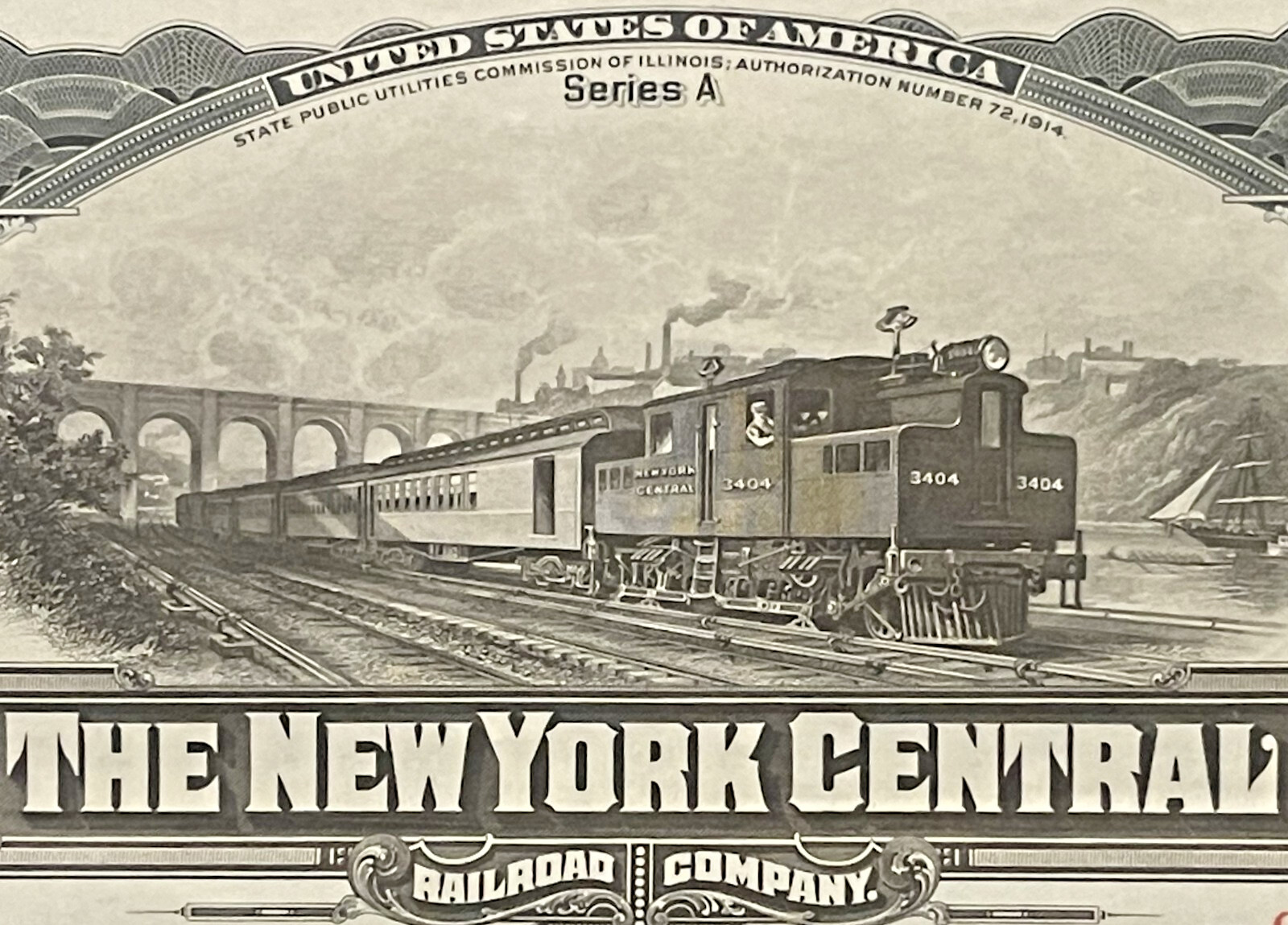
This is an antique New York Central Railroad Company Four Per Cent Consolidation Mortgage Gold Bond, Series A, in the $1,000 denomination, engraved and printed by the American Bank Note Company of New York, with principal and interest made payable at the railroad's office in the Borough of Manhattan, City of New York. The bond is dated to 1913 — the year printed on its own face — and measures approximately 15 x 10 inches (about 38 x 25 cm), printed in black and grayish-green intaglio ink on cream, security-grade stock. The top of the certificate carries a sweeping arched banner reading "UNITED STATES OF AMERICA" and referencing authorization from the State Public Utilities Commission of Illinois, a regulatory footnote that tells its own story about how railroad securities were sold and cleared across state lines in this period. Below that arch sits the certificate's centerpiece: a wide steel-engraved vignette of a New York Central electric locomotive, its train of varnished passenger cars trailing behind it, running along the water's edge beneath a soaring multi-arch stone viaduct, with a tall-masted sailing vessel drifting on the river behind it and a smoke-hazed industrial skyline in the distance. Beneath the image, the company name rings out in bold engraved lettering — THE NEW YORK CENTRAL RAILROAD COMPANY — over dense, small-set legal text describing the terms of the mortgage, framed on all sides by the elaborate lathe-work guilloche borders that were the signature of American Bank Note's finest security engraving. An embossed blind corporate seal and hand-inked signatures of a Vice-President and Assistant Secretary complete the face of the bond. This is offered as new old stock, drawn from surviving railroad-finance archives rather than circulated as currency — a genuine, uncirculated survivor of early twentieth-century American corporate engraving.
🏛️ The Road That Built an EmpireThe New York Central story reaches back to 1853, when a cluster of small upstate New York railroads consolidated into a single trunk line stretching from Albany to Buffalo. Under the control of Commodore Cornelius Vanderbilt and his heirs, the railroad grew into one of the great transportation empires of the industrial age, eventually running its "Water Level Route" — so named because, unlike its mountain-climbing rival the Pennsylvania Railroad, the New York Central's main line followed the gentle grades of the Hudson and Mohawk river valleys — all the way from New York City and Boston through Albany, Utica, Syracuse, Rochester, and Buffalo, and on to Cleveland, Detroit, Cincinnati, Chicago, and St. Louis. It was, for generations, the dominant railroad of the American Northeast and Midwest, headquartered in the New York Central Building at 230 Park Avenue, built directly astride the tracks leading into its crown jewel, Grand Central Terminal. Collectors of railroad ephemera often point out that the Central's passenger trains — the 20th Century Limited above all — became a cultural shorthand for luxury and speed, the train that carried presidents, financiers, and film stars between New York and Chicago on the legendary red carpet rolled out for it at Grand Central. The railroad's fortunes eventually declined alongside the American passenger rail industry generally, and in 1968 the New York Central merged with its longtime rival the Pennsylvania Railroad to form the short-lived and famously troubled Penn Central Transportation Company.
🌉 The Story Behind the VignetteThe engraved scene on this bond is not a generic decorative railroad image — it depicts an electric locomotive, a detail that ties directly to one of the pivotal moments in New York Central history. In January 1902, a devastating collision inside the smoke-filled Park Avenue Tunnel killed more than a dozen people and forced a public reckoning with steam locomotives operating in Manhattan's underground approaches. The result was a sweeping decision to electrify the railroad's approach into the city and to replace the old Grand Central Depot entirely with a new, grander terminal built on multiple underground levels — the Grand Central Terminal that still stands today, which opened its doors in 1913, the very year this bond issue is dated. The electric locomotive shown pulling its passenger consist past a great stone viaduct on this certificate is a direct visual reference to that transformation: the New York Central of 1913 was a railroad in the middle of remaking itself, trading steam and smoke for electric power at its most important gateway. Collectors who study these vignettes closely have long enjoyed tracing the riverside, viaduct, and harbor imagery back to the Hudson Line's dramatic run along the water, a stretch of track still traveled today by Metro-North commuters who may have no idea their route was once mortgaged, quite literally, to bondholders like the one who once held this certificate.
💰 The 1913 Consolidation and the Financial Machinery Behind ItThe bond's own text tells a story of corporate consolidation as much as railroad engineering. It identifies the issuing company as the New York Central Railroad Company formed by the merger of the New York Central and Hudson River Railroad Company, the Lake Shore and Michigan Southern Railway Company, and other affiliated lines — one of the great corporate unifications of the early twentieth-century rail industry, binding together what had been a patchwork of separately chartered companies into a single operating system stretching from the Atlantic seaboard to the Great Lakes. To finance and refinance this newly consolidated system, the railroad executed an indenture of mortgage and deed of trust dated June 20, 1913, naming Bankers Trust Company of New York as trustee — authorizing an eventual total of $167,102,400 in Consolidation Mortgage Gold Bonds across four separate series designated A, B, C, and D, each series structured to retire or exchange for older underlying debt, such as the New York Central and Hudson River's earlier 3½ per cent gold bonds and Lake Shore collateral bonds. Series A bonds, like this one, were issued for cash to raise fresh capital rather than simply exchanged for older paper — meaning bonds of this series represent real new money raised from investors betting on the future of America's railroads. The bonds carried a four per cent annual interest rate, paid twice yearly on February 1st and August 1st, "in gold coin of the United States," with a startlingly distant maturity date of February 1st, 1998 — an eighty-five-year term that must have seemed, to a 1913 investor, almost unimaginably far in the future. Bankers Trust Company, the trustee named on the certificate, was itself a young but rapidly rising Wall Street institution at the time, founded in 1903 and destined to become one of the twentieth century's most important American banks before its eventual absorption into Deutsche Bank at the close of the 1990s — coincidentally, right around the same years these very bonds were scheduled to mature.
🖨️ The Engraver's CraftEvery element of this certificate — the dense guilloche lathe-work bordering the edges, the fine cross-hatched shading in the locomotive vignette, the crisp lettering of the company name — is the product of the American Bank Note Company, the preeminent security engraving house of its era. Founded in the mid-nineteenth century and entrusted with printing currency, postage stamps, and negotiable securities for governments and corporations across the Americas, American Bank Note built its reputation on exactly the kind of intricate, near-impossible-to-forge steel-plate intaglio work on display here: raised, tactile ink laid down under enormous plate pressure, geometric guilloche patterns generated by precision lathe engines, and a густой, deliberately overwhelming density of fine-line ornament meant to defeat the forger's hand. The red overprinted numbering, the hand-inked officer signatures, and the embossed corporate seal were all part of a layered security system designed for an age before microprinting or holograms — when the only defense against counterfeiting was the sheer, patient skill of the engraver.
📉 From Gold Bond to Ghost RailroadThe New York Central Railroad Company that issued this bond no longer exists under its own name — its 1968 merger into Penn Central was followed, within just a few years, by one of the most spectacular corporate bankruptcies in American history, a collapse that helped push Congress toward the creation of Conrail and, eventually, Amtrak's takeover of intercity passenger service. Much of the physical railroad this bond once helped finance is still very much alive, however: the Hudson Line these vignettes so proudly depict is today one of the busiest commuter corridors in the country, run by Metro-North Railroad, and Grand Central Terminal — the building this 1913 electrification program was built to serve — remains one of the most visited and photographed landmarks in New York City. Lore passed down among railroad bond collectors holds that surviving Consolidation Mortgage gold bonds like this one are disproportionately common in the higher, more prestigious Series A precisely because it represented the largest authorized tranche of the 1913 issue — a detail that makes tracing an individual bond's place within that four-series structure part of the fun for anyone assembling a serious New York Central paper collection.
🖼️ Display Ideas- 🚂 Framed alone as a bold graphic centerpiece in a home office, den, or study — the locomotive vignette holds its own even at a glance across the room
- 🗺️ Paired with a period map of the New York Central system or the Hudson River line for a wall grouping that tells a geographic story
- 🏙️ Displayed alongside Grand Central Terminal photography or postcards to connect the bond directly to the 1913 electrification story
- 📚 Shelved or matted in a library or train room next to other early railroad and financial ephemera
- 💼 Set in a shadow box with other Gilded Age and Progressive Era stock and bond certificates to build a broader "building of America" theme
- 🎁 Given as a milestone or retirement gift for a railroad enthusiast, financial historian, or lifelong New Yorker
Railroad bond and stock certificates like this one sit at the crossroads of several collecting worlds. Scripophily collectors — those who focus specifically on antique financial documents — prize New York Central material for its engraving quality and its connection to one of the defining corporations of the American industrial age. Railroad historians and railroadiana collectors seek it out for the locomotive vignette and the direct tie to the Grand Central electrification story. Americana and ephemera collectors like it simply as a strikingly engraved piece of early twentieth-century commercial art, worthy of framing on its own merits. And because the New York Central name still carries real weight with New Yorkers and transportation history buffs alike, it's a natural gift for anyone with roots in the Hudson Valley, the city itself, or a family history tied to the rails.
❓ FAQIs this an original 1913 bond or a reproduction?This is an authentic, original antique certificate from the New York Central Railroad Company's 1913 Consolidation Mortgage Gold Bond issue, engraved by the American Bank Note Company — not a modern reprint or facsimile.
Was this bond ever paid out or redeemed?Consolidation Mortgage Gold Bonds of this series carried an 1998 maturity date, so surviving examples reflect the long life of railroad-era financial instruments rather than a modern security — the piece is offered as new old stock from long-held archival material.
What does the vignette actually depict?It shows a New York Central electric locomotive pulling a passenger train past a stone viaduct along the water, imagery tied to the railroad's early 1900s electrification of its approach into Manhattan and the construction of the new Grand Central Terminal, completed in 1913.
How big is the certificate?It measures approximately 15 x 10 inches (about 38 x 25 cm), true to the large, formal scale typical of early twentieth-century American corporate bonds.
Who was Bankers Trust Company, named as trustee?Bankers Trust was a major New York financial institution founded in 1903 that served as trustee for the mortgage securing this bond issue — it later grew into one of the twentieth century's most significant American banks.
Does the "Series A" designation matter for collectors?Yes — the underlying 1913 mortgage authorized four series (A, B, C, and D) totaling over $167 million in bonds, with Series A representing the largest tranche of fresh capital raised in cash rather than exchanged for older debt.
How should I care for and display it?Most collectors choose UV-filtering glass or acrylic and acid-free matting to preserve the engraving's contrast and protect the paper long-term while showing off the vignette and lettering.
Related Items:
Vintage Magnifying Glass 10X Wood Antique Brass Handheld Magnifier
$3.60

RARE Armor Antique Silver Zippo Japanese H.R Giger Museum Alien Zippo Lighter
$159.95

RARE Signed B&D HOUSE NOS 6" CERAMIC Tile Farm house Country Cottage Trivet
$3.00