




 On eBay Now...
Antique 1800s Victorian Candy Box Insert 👒 Blue Hat Lady German Chromolith NOS For Sale
When you click on links to various merchants on this site and make a purchase, this can result in this site earning a commission. Affiliate programs and affiliations include, but are not limited to, the eBay Partner Network.

Antique 1800s Victorian Candy Box Insert 👒 Blue Hat Lady German Chromolith NOS:
$19.95
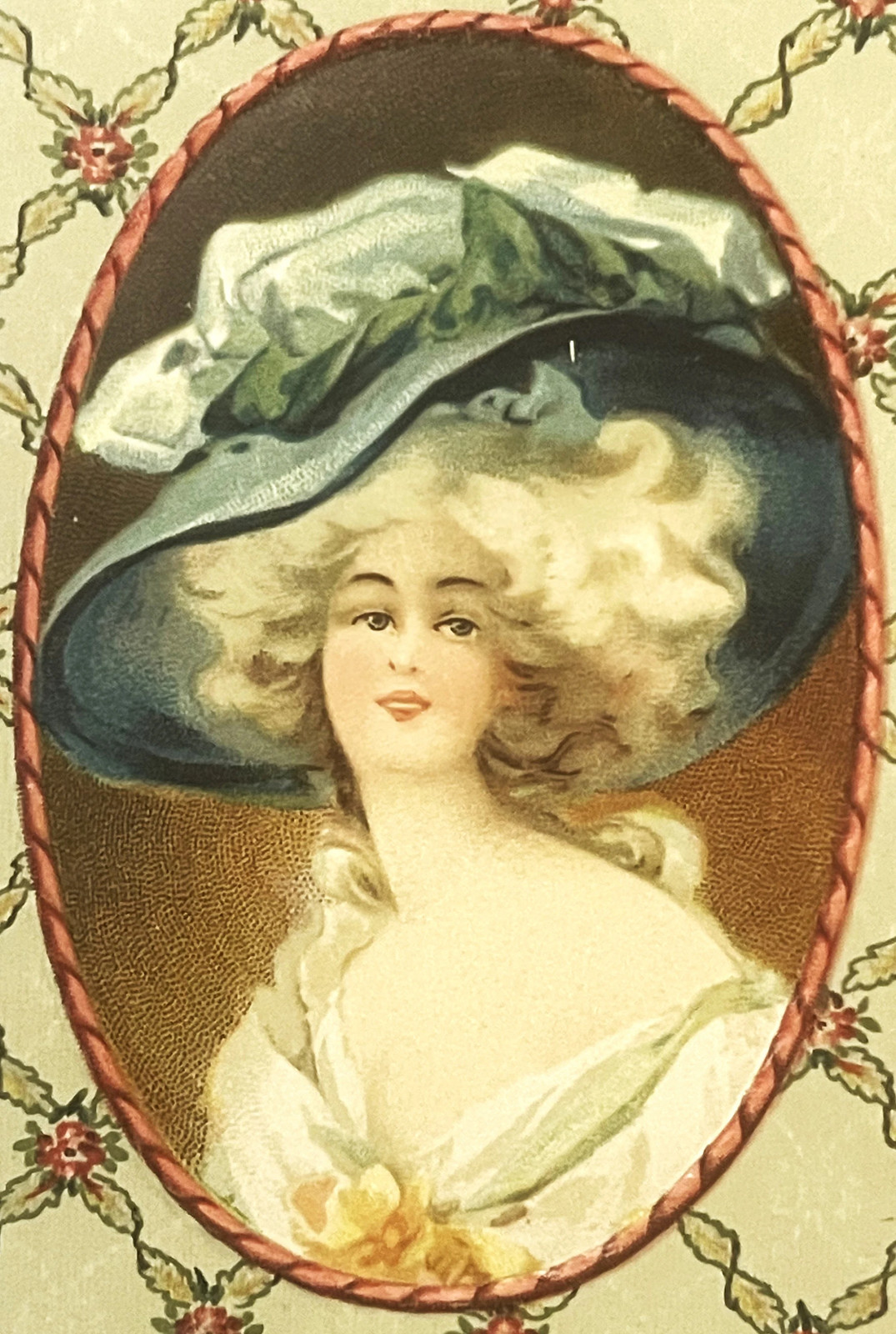
Antique 1800s Victorian Candy Box Insert, Blue Plumed Hat Lady, Printed in GermanyNew old stock, never used and never mounted on a box. The color is bright, the embossed rope border stands crisp, and the kraft back is clean.
The Lady Who Never Made It Onto a BoxConfectioners in the 1800s wrapped their boxes in pictures like this one before a customer ever saw the candy inside, and buyers so often kept the lid art after the sweets were gone that plenty of these outlived the business they advertised. These never got that far - never glued to a box, the embossed oval still standing proud off the board. A white off-the-shoulder gown and a small yellow rose at the bodice sit against a stippled copper-brown ground inside that oval, itself ringed by a pale green leafy lattice with red rosettes at the crossings. Two tiny words at the base explain a lot: PRINTED IN GERMANY, a line that turns out to hang on a British law gone wrong and an American tariff that ended a congressman's career. And the enormous plumed hat framing her face isn't just decoration - it's a direct nod to Thomas Gainsborough's 18th-century society portraits, recycled by candy printers a hundred years on.
One Gainsborough portrait in particular made that hat famous well beyond the art world. His painting of Georgiana, Duchess of Devonshire sold for a record sum in London in 1876, then disappeared three weeks later from the gallery of Thomas Agnew & Sons - stolen by Adam Worth, a thief so notorious Scotland Yard nicknamed him the "Napoleon of Crime" (and whom some credit as Arthur Conan Doyle's model for Professor Moriarty). Worth held onto the canvas for a quarter century before it finally turned up again in Chicago on March 28, 1901. All through that stretch, the wide plumed brim from the stolen portrait had already become a fashion trend in its own right from 1878 on, piled with feathers and ribbon and revived again decades later under the Gibson Girl look.
The candy-box tradition itself traces to a Cadbury: Richard Cadbury, running the family Birmingham firm with his brother George starting in 1861, put his own painting of his daughter holding a kitten on a box lid in 1868 and effectively invented the fancy chocolate box - the same year his company sold its first heart-shaped Valentine's assortment. Buyers on this side of the Atlantic weren't far behind; John Huyler built a New York candy operation from 1874 into 54 stores and 14 factories with about 2,000 employees by 1910, briefly the country's largest chocolate maker.
As for that country-of-origin stamp: Britain's Merchandise Marks Act of 1887 forced imported goods to name their source, meaning to warn shoppers off German knockoffs, and it backfired completely - "Made in Germany" ended up reading as a mark of quality rather than caution, a shift Ernest Edwin Williams cemented with his 1896 book Made in Germany, a runaway best-seller that ran through six editions inside a year. The United States followed with its own version, the McKinley Tariff, signed into law October 1, 1890 by a bill steered through the House Ways and Means Committee by its chairman, Congressman William McKinley of Canton, Ohio - it raised average duties to nearly 50 percent and required English-language origin labels on imports starting March 1, 1891; McKinley lost his own House seat over the price increases it caused, though voters made him president six years later anyway. Both laws are why this small piece of printed Germany ended up on an American candy box in the first place.
The rich, layered color came from chromolithography, a refinement of the lithography Bavarian playwright Alois Senefelder invented in 1796 while hunting for a cheaper way to print his own scripts - each color pulled from its own separately inked stone. It reached America by 1840, when William Sharp made the country's first chromolithograph, a portrait of the Reverend F. W. P. Greenwood, and by the late 1800s the process was dressing cigar boxes and trade cards as readily as candy lids, with German houses - Leipzig among the great centres - leading the trade. And the hat itself had a real-world cost behind its beauty: plume hunters were wiping out herons and egrets by the millions for the millinery trade until two Boston women, Harriet Hemenway and Minna Hall, talked their social circle out of feathered hats over tea in 1896, launching the Massachusetts Audubon Society, which helped push through a Massachusetts law banning the wild-feather trade in 1897, and eventually the federal Lacey Act. The fashion didn't die easily - Lily Elsie's enormous feathered hat in London's 1907 Merry Widow premiere sparked another wave, and hatpins grew so long in response that Chicago's city council capped them at nine inches by 1910.
SPECIFICATIONS- Type: embossed chromolithograph candy box insert card
- Design: bust portrait, blue plumed "Gainsborough" hat, coral rope-twist border
- Marked: PRINTED IN GERMANY, lower left
- Process: chromolithography on heavy card stock
- Reverse: plain kraft-tan board, oval pressed through in relief

Antique 1800s Pope Pius VII Holy Family Wood Shadow Box Jesus Joseph Mary
$150.00

Antique 1800s Silk Handmade Pocket Pouch Victorian Floral Striped Textile 1700s?
$112.00

P131- Early 1800s Antique Jacob Heiss Lancaster Pa Wood Molding Plane
$200.00